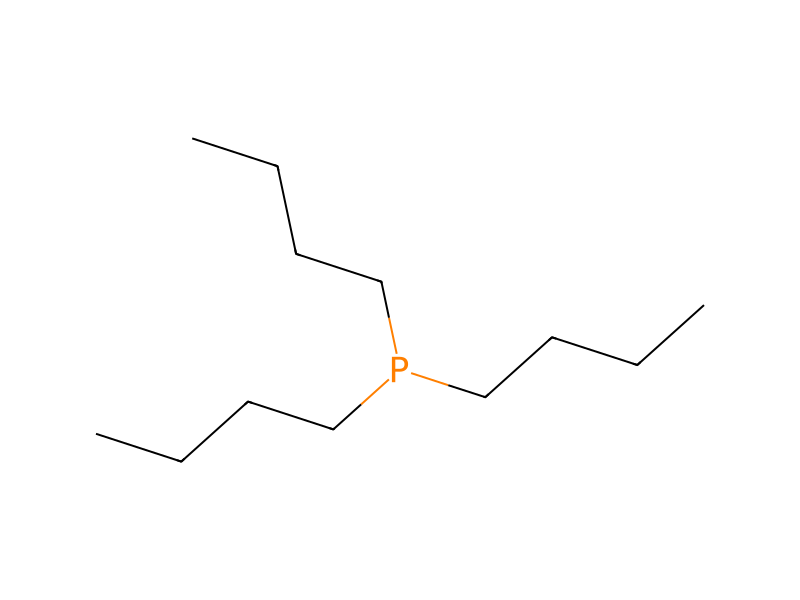
Tributylphosphine → HCID 54199326, compound
Reaction equation

[CH2:1]([O:3][C:4](=[O:18])[C:5](=[N+:16]=[N-:17])[C:6]([C:8]1[CH2:14][CH2:13][CH2:12][CH2:11][CH2:10][C:9]=1Cl)=[O:7])[CH3:2].C(P(CCCC)CCCC)CCC>O1CCOCC1>[CH2:1]([O:3][C:4]([C:5]1[C:6](=[O:7])[C:8]2[CH2:14][CH2:13][CH2:12][CH2:11][CH2:10][C:9]=2[NH:17][N:16]=1)=[O:18])[CH3:2]Participants
Reactant 2

Product 1

Reagents, catalysts & solvents 1

Procedure
To a solution of 3-(2-chlorocyclohept-1-enyl)-2-diazo-3-oxopropionic acid ethyl ester (1 g) in 1,4-dioxan (20 ml) was added a solution of tri-n-butylphosphine (1 ml) in 1,4-dioxan (10 ml). On completion of the addition the reaction mixture was stirred at room temperature for 30 minutes then heated to reflux for 2 h. The solvent was evaporated under reduced pressure and the residue purified by chromatography using a gradient elution: CH2Cl2 (250 ml), CH2Cl2/MeOH 99:1 (250 ml), CH2Cl2/MeOH 98:2 (250 ml), CH2Cl2/MeOH 97:3 (250 ml), CH2Cl2/MeOH 96:4 (250 ml). The appropriate fractions were combined and evaporated under reduced pressure to give a solid (360 mg, 41%). C12H16N2O3 requires C, 61.00; H, 6.83; N, 11.86. Found C, 60.80; H, 6.88; N, 11.84%. δH (250 MHz; CDCl3) 1.42 (3H, t, J=7 Hz, CH3), 1.62 (2H, m, CH2), 1.73 (2H, m, CH2), 1.87 (2H, m, CH2), 2.86 (2H, m, CH2), 3.09 (2H, m, CH2), 4.48 (2H, t, J=7 Hz, CH2), m/z (ESP+) 237 (MH+).
Workup
- additionOn completion of the addition the reaction mixture
- temperaturethen heated
- temperatureto reflux for 2 h
- customThe solvent was evaporated under reduced pressure
- customthe residue purified by chromatography
- washa gradient elution
- customevaporated under reduced pressure
Sources & evidence
- ORD record
- ord-98847f1b965f41eba4a8e4c1dcab45a2
- Source dataset
- uspto-grants-2001_01
- Patent number
- US06180630B2
Reaction notes
Loading…