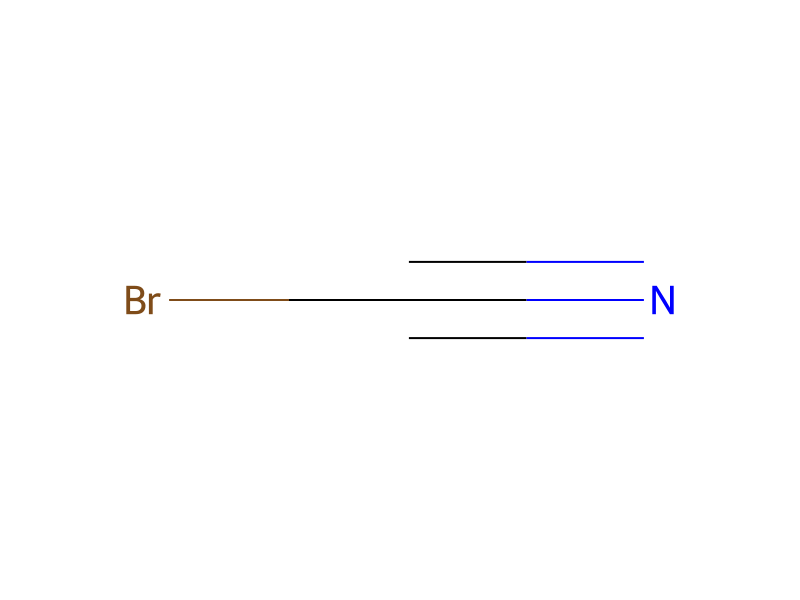
Cyanogen Bromide → HCID 178429220, compound
Reaction equation

[NH2:1][C:2]1[CH:3]=[C:4]2[C:8](=[CH:9][C:10]=1[NH2:11])[NH:7][C:6](=[O:12])[C:5]2([CH3:14])[CH3:13].[N:15]#[C:16]Br>C(O)C>[CH3:13][C:5]1([CH3:14])[C:4]2[C:8](=[CH:9][C:10]3[NH:11][C:16]([NH2:15])=[N:1][C:2]=3[CH:3]=2)[NH:7][C:6]1=[O:12]Participants
4
Reactant 2

Product 1

Reagents, catalysts & solvents 1

Procedure
3.00 g. (0.016 mole) 5,6-diamino-3,3-dimethylindolin-2-one are suspended in 100 ml. ethanol and mixed at ambient temperature with 1.82 g. (0.017 mole) cyanogen bromide and stirred for 2 hours. The solvent is removed in a vacuum and the residue is dissolved in ethanol, treated with active charcoal and the product precipitated out by the addition of acetone. The product is crystallised from acetone and a little ethanol to give 1.05 g. (22% of theory) of the title compound in the form of the hydrobromide; m.p. 300°-305° C.
Workup
- customThe solvent is removed in a vacuum
- dissolutionthe residue is dissolved in ethanol
- additiontreated with active charcoal
- customthe product precipitated out by the addition of acetone
- customThe product is crystallised from acetone
- customa little ethanol to give 1.05 g
Sources & evidence
- ORD record
- ord-083791cb6af04aafa82eac936ee269af
- Source dataset
- uspto-grants-1988_03
- Patent number
- US04730003
Reaction notes
Loading…