Ethylenediamine → 3-Phenyl-1,4,5,6-tetrahydropyrazine-2-carbonitrile
Reaction equation

[C:1]1([C:7]([CH:9]=O)=O)[CH:6]=[CH:5][CH:4]=[CH:3][CH:2]=1.OS([O-])=O.[Na+].[CH2:16]([NH2:19])[CH2:17][NH2:18].[C-:20]#[N:21].[Na+]>O.CO>[C:1]1([C:7]2[NH:19][CH2:16][CH2:17][NH:18][C:9]=2[C:20]#[N:21])[CH:6]=[CH:5][CH:4]=[CH:3][CH:2]=1Participants
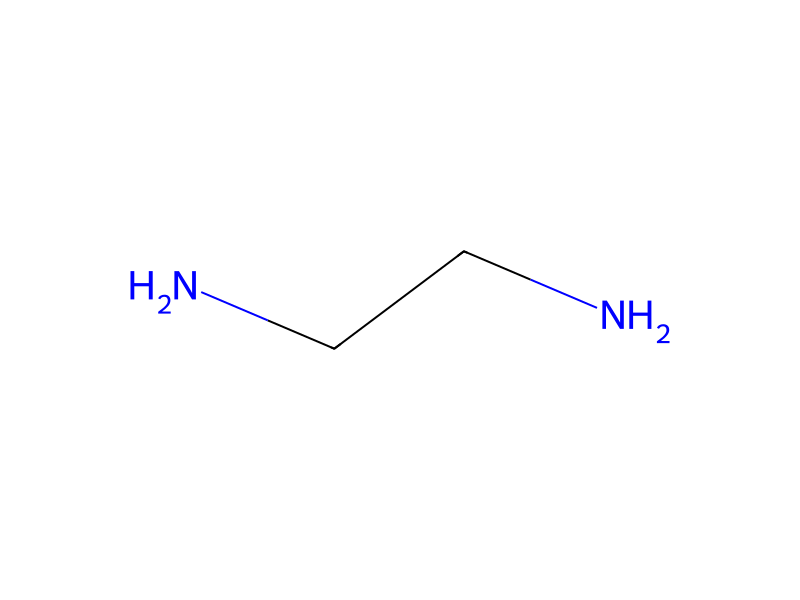






Conditions
- Temperature
- 50 °C
Procedure
13.8 parts of phenylglyoxal and 40 parts by volume of water are initially taken and heated to about 50° C., 61 parts of 38% strength aqueous NaHSO3 solution are introduced, and methanol is added in an amount sufficient to dissolve virtually all solid material. Thereafter, 6 parts of ethylenediamine are added at about 30° C., the mixture is heated at 50° C. for 30 minutes and then cooled to about 10° C., a solution of 5.2 parts of 95% pure NaCN in 13 parts by volume of water is added at this temperature, stirring is continued for a further 2 hours at room temperature and working up is carried out as described under Example 4. 10 parts (54% of theory) of 1,4,5,6-tetrahydro-3-phenyl-2-cyanopyrazine are obtained in the form of a reddish brown, viscous oil. The mass spectrum of this product shows the molecular peak expected for the empirical formula C11H11N3, at e/m=185, and its NMR spectrum exhibits the bands typical of the different NH groups, at about 3.5 ppm (N1 -H) and about 6.15 ppm (N4 -H).
Workup
- dissolutionto dissolve virtually all solid material
- temperaturethe mixture is heated at 50° C. for 30 minutes
- temperaturecooled to about 10° C.
Sources & evidence
- ORD record
- ord-271a8c3dce49462ea99cf70ef5d32c70
- Source dataset
- uspto-grants-1988_03
- Patent number
- US04734499
Reaction notes
Loading…