Hydrogen Peroxide → Cyclohexanol
Reaction equation

Cl[C:2]1[CH:7]=[CH:6][CH:5]=[CH:4][C:3]=1Cl.[CH2:9]1[CH2:14][CH2:13][CH2:12][CH2:11][CH2:10]1.[OH:15][OH:16]>C(#N)C>[C:2]1(=[O:15])[CH2:7][CH2:6][CH2:5][CH2:4][CH2:3]1.[CH:9]1([OH:15])[CH2:14][CH2:13][CH2:12][CH2:11][CH2:10]1.[CH:2]1([O:15][OH:16])[CH2:7][CH2:6][CH2:5][CH2:4][CH2:3]1Participants
Reactant 3



Product 3
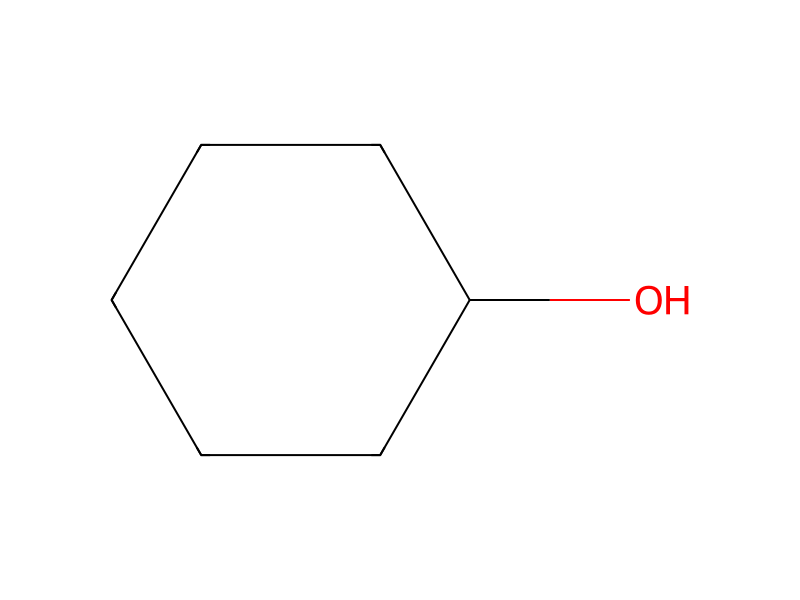


Reagents, catalysts & solvents 1

Procedure
Synthesize alkane oxidation catalyst in situ and oxidize alkane (cyclohexane) as follows. Add SiO2—C (3.3 mg, 0.6 groups/nm2) in acetonitrile (2 mL) and ([(C6H12N3R3)Mn2O3]Z2) (0.2 mM) to a container. The carboxylate group to Mn atom ratio is 0.50:1.0. Add o-dichlorobenzene (100 microliter (μL), 390 mmol) and cyclohexane (50 μL, 200 mmol) to the contents of container and maintain at 0° C. Add H2O2 (30 weight percent (wt %), 130 μL) to the contents of container. Seal the container and react to produce an alkane oxidation product (cyclohexanone (CyO), cyclohexanol (CyOH), and/or cyclohexyl hydroperoxide (Cy-OOH)). The concentrations of these species are determined as a function of time using gas chromatography and are shown in Table 1.
Workup
- customSeal the container
- customreact
Sources & evidence
- ORD record
- ord-3106ce0eb18147379849d36e5eceb626
- Source dataset
- uspto-grants-2015_05
- Patent number
- US09024076B2
Reaction notes
Loading…