Ethanol → HCID 3002907, compound
Reaction equation
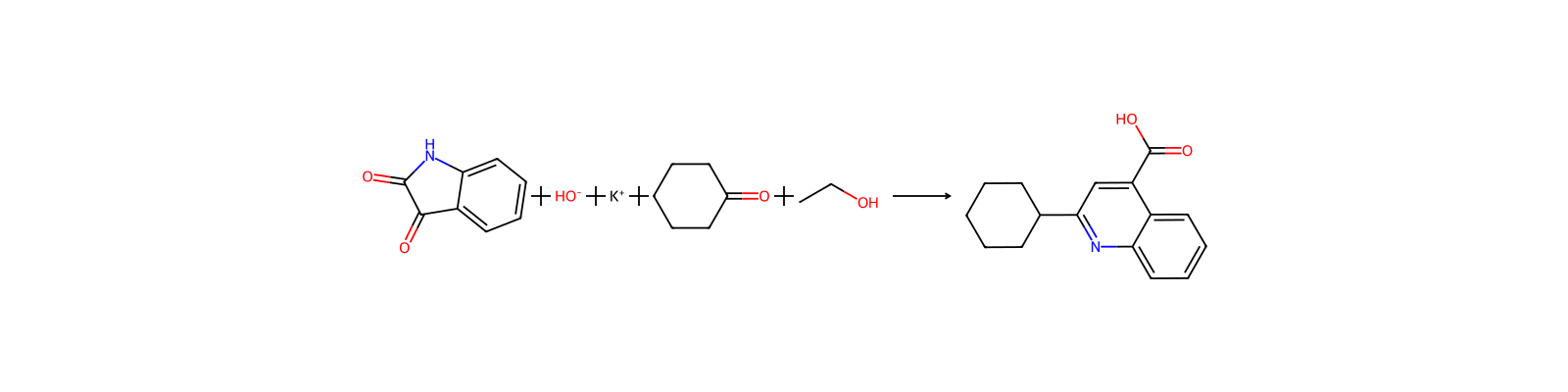
[NH:1]1[C:11]2[C:6](=[CH:7][CH:8]=[CH:9][CH:10]=2)[C:4](=O)[C:2]1=[O:3].[OH-:12].[K+].[C:14]1(=O)[CH2:19][CH2:18][CH2:17][CH2:16][CH2:15]1.[CH2:21](O)[CH3:22]>>[CH:14]1([C:21]2[CH:22]=[C:4]([C:2]([OH:12])=[O:3])[C:6]3[C:11](=[CH:10][CH:9]=[CH:8][CH:7]=3)[N:1]=2)[CH2:19][CH2:18][CH2:17][CH2:16][CH2:15]1Participants
5





Procedure
A mixture of 2.94 g (0.02 mole) isatine and 50 ml ethanol and 2.24 g (0.04 mole) potassium hydroxide and 2 g (0.02 mole) cyclohexanone is refluxed to give cyclohexylquinoline-4-carboxylic acid. This acid is dried and dissolved in 50 ml THF and 2 ml ethylchloroformate and 2 ml three ethylamine are added over an ice bath. After 3 hrs stirring 3.9 g (0.02 mole) 4-aminophenoxyisobutyric acid is added and stirring continued for 4 hrs. After filtration most of THF is evaporated and diluted with water and acidified with hydrochloric acid to get the final compound. The structure is structure 18. C29H20N2O4 mw 400 If other cyclic ketones such as cycloheptanone are used the corresponding cycloheptyl compound is obtained.
Workup
- temperatureis refluxed
Sources & evidence
- ORD record
- ord-b92b101668aa482289401381f70c4a0a
- Source dataset
- uspto-grants-2015_05
- Patent number
- US09040553B2
Reaction notes
Loading…