Diisopropylethylamine → 3-chloro-6-[(2R,6S)-2,6-dimethylmorpholin-4-yl]-7-fluoro-1,2-benzoxazole-5-carbaldehyde
Reaction equation
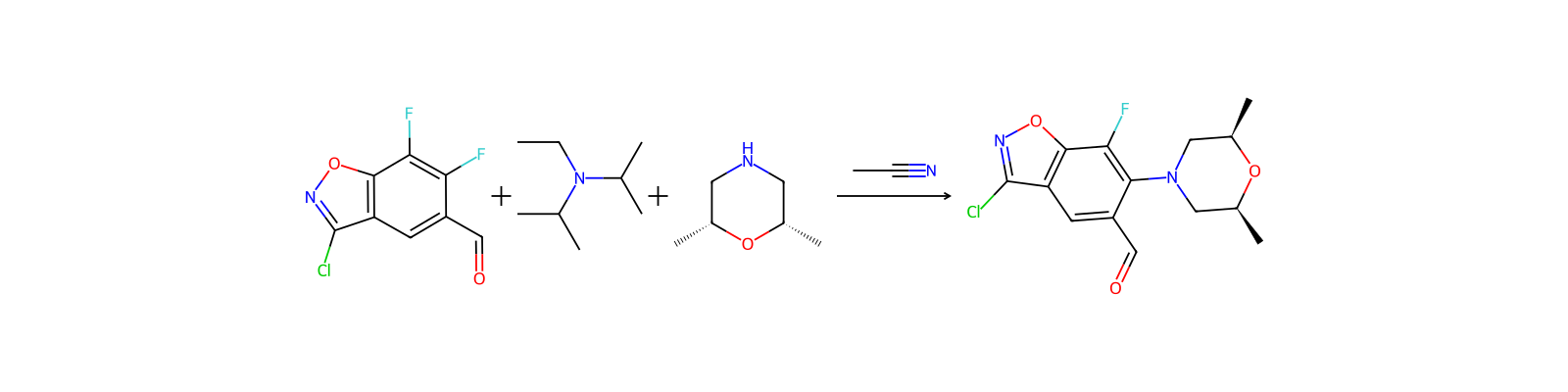
[Cl:1][C:2]1[C:6]2[CH:7]=[C:8]([CH:13]=[O:14])[C:9](F)=[C:10]([F:11])[C:5]=2[O:4][N:3]=1.CCN(C(C)C)C(C)C.[CH3:24][C@H:25]1[O:30][C@@H:29]([CH3:31])[CH2:28][NH:27][CH2:26]1>C(#N)C>[Cl:1][C:2]1[C:6]2[CH:7]=[C:8]([CH:13]=[O:14])[C:9]([N:27]3[CH2:26][C@H:25]([CH3:24])[O:30][C@H:29]([CH3:31])[CH2:28]3)=[C:10]([F:11])[C:5]=2[O:4][N:3]=1Participants
5
Reactant 3



Product 1

Reagents, catalysts & solvents 1

Conditions
- Temperature
- 85 °C
Procedure
To an ice cooled and stirred solution of 3-chloro-6,7-difluorobenzo[d]isoxazole-5-carbaldehyde (Intermediate 532, 1.0 g, 8.75 mmol) in anhydrous acetonitrile was added DIPEA (1.8 mL, 10.5 mmol) followed by cis 2,6-dimethylmorpholine (1.3 mL, 10.5 mmol) and the mixture heated at 85° C. for 4 hours. It was cooled to room temperature and concentrated. The residue was dissolved in ethyl acetate, washed with water followed by brine and then dried over anhydrous sodium sulfate. It was filtered and the filtrate evaporated under reduced pressure. The residue was purified over silica gel column using a gradient of ethylacetate in pet.ether to give title compound as solid. Yield: 2.3 g (85%).
Workup
- temperatureIt was cooled to room temperature
- concentrationconcentrated
- dissolutionThe residue was dissolved in ethyl acetate
- washwashed with water
- dry with materialdried over anhydrous sodium sulfate
- filtrationIt was filtered
- customthe filtrate evaporated under reduced pressure
- customThe residue was purified over silica gel column
Sources & evidence
- ORD record
- ord-25edadc7785d4705912e647c8711fb28
- Source dataset
- uspto-grants-2015_05
- Patent number
- US09040528B2
Reaction notes
Loading…