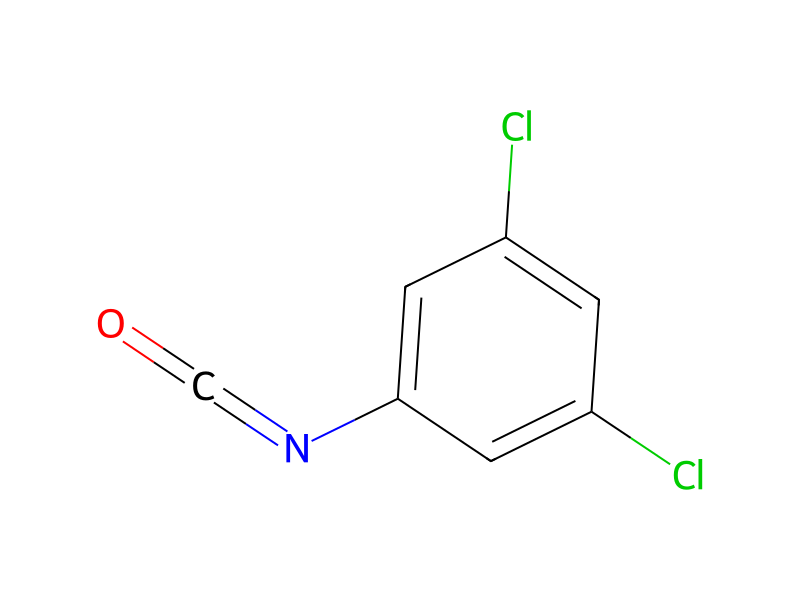
3,5-Dichlorophenyl isocyanate → 3-(3,5-Dichlorophenyl)-5-methyl-1-(prop-2-yn-1-yl)imidazolidine-2,4-dione
Reaction equation

[CH2:1]([NH:4][CH:5]([CH3:10])[C:6]([O:8]C)=O)[C:2]#[CH:3].[Cl:11][C:12]1[CH:13]=[C:14]([N:19]=[C:20]=[O:21])[CH:15]=[C:16]([Cl:18])[CH:17]=1>C1(C)C=CC=CC=1.CCCCC(C([O-])=O)CC.CCCCC(C([O-])=O)CC.[Sn+2]>[Cl:11][C:12]1[CH:13]=[C:14]([N:19]2[C:6](=[O:8])[CH:5]([CH3:10])[N:4]([CH2:1][C:2]#[CH:3])[C:20]2=[O:21])[CH:15]=[C:16]([Cl:18])[CH:17]=1Participants
5



Procedure
To a solution of 10 g (0.07 mole) of methyl 2-propargylaminopropionate in 100 ml of toluene with 2 drops of stannous octoate is added 14.5 g (0.077 mole) of 3,5-dichlorophenylisocyanate in small portions. The resulting mixture is heated at 100° for 3 hours. It is then washed with water twice and dried over sodium sulfate. Solvent is evaporated to give a thick yellow oil. Material is further purified by passing it through a silica gel column using 30/70 ethyl acetate/hexane as solvent to give 18 g of a light yellow oil which solidifies on standing. The solids are triturated in boiling hexane and collected by filtration, mp 105°-6°. NMR and elemental analysis confirm the desired structure.
Workup
- temperatureThe resulting mixture is heated at 100° for 3 hours
- washIt is then washed with water twice
- dry with materialdried over sodium sulfate
- customSolvent is evaporated
- customto give a thick yellow oil
- customMaterial is further purified
Sources & evidence
- ORD record
- ord-220825e5ebc940af9901097608acea03
- Source dataset
- uspto-grants-1988_06
- Patent number
- US04753957
Reaction notes
Loading…