1-Bromooctane → 1-Iodooctane
Reaction equation

Br[CH2:2][CH2:3][CH2:4][CH2:5][CH2:6][CH2:7][CH2:8][CH3:9].[I-:10]>ClC1C=CC=CC=1>[I:10][CH2:2][CH2:3][CH2:4][CH2:5][CH2:6][CH2:7][CH2:8][CH3:9]Participants
Reactant 2
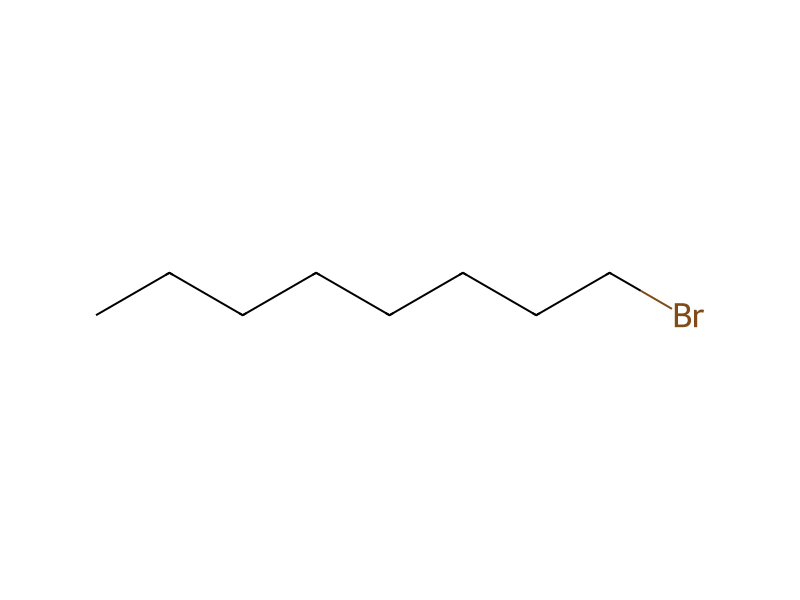

Product 1

Reagents, catalysts & solvents 1

Procedure
A reaction using the above reactor was conducted using the following chemistry. Bromooctane in the organic solvent chlorobenzene was reacted with aqueous iodide to form iodoctane in chlorobenzene and aqueous bromide ion. To ensure that this reaction required the use of a phase transfer catalyst, a brief dispersed-phase study was conducted. A solution 0.5 M in bromooctane and 0.1 M in tetradecane (as a gas chromatograph standard) in chlorobenzene was stirred with an equal volume of 2.0 M potassium iodide at 40 degrees C. for 4 hours. After this period, no iodooctane could be detected by gas chromatography. All analyses were conducted with a Perkin-Elmer 3920 gas chromatograph equipped with a flame ionization detector and a 10' by 1/8" OV-101 column at 200 degrees C. When this experiment was repeated using 0.05 M tetrabutylammonium bromide in the organic feed as a phase transfer catalyst, 50% conversion of bromooctane to iodoctane was observed after 4 hours. Because the organic-phase concentration of tetrabutylammonium iodide, the active form of the catalyst, remains constant with time under these reaction conditions, first-order kinetics with respect to the disappearance of bromooctane is predicted by the phase transfer catalysis mechanism. This effect was observed in these experiments.
Sources & evidence
- ORD record
- ord-9cc2e1e8c7794e8e81d3b1c13069924d
- Source dataset
- uspto-grants-1988_06
- Patent number
- US04754089
Reaction notes
Loading…