4-Hydroxybenzoic Acid → Benzyl 4-Hydroxybenzoate
Reaction equation

[OH:1][C:2]1[CH:10]=[CH:9][C:5]([C:6]([OH:8])=[O:7])=[CH:4][CH:3]=1.[CH2:11](OC(=NC(C)C)NC(C)C)[C:12]1[CH:17]=[CH:16][CH:15]=[CH:14][CH:13]=1>O1CCCC1>[OH:1][C:2]1[CH:10]=[CH:9][C:5]([C:6]([O:8][CH2:11][C:12]2[CH:17]=[CH:16][CH:15]=[CH:14][CH:13]=2)=[O:7])=[CH:4][CH:3]=1Participants
Reactant 2
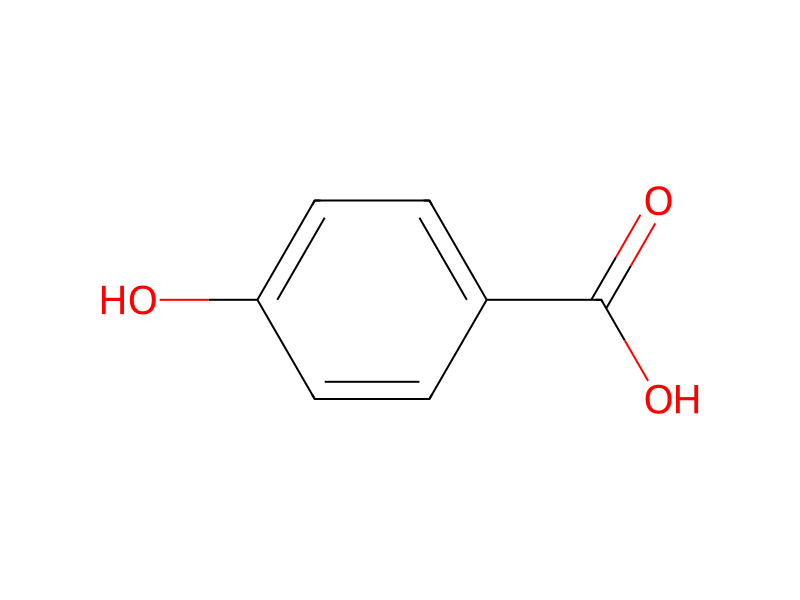

Product 1

Reagents, catalysts & solvents 1

Procedure
A neat solution of 18.6 mL (15 g, 118.8 mmol) of 1,3-diisopropylcarbodiimide and 60 mg (0.6 mmol) of cuprous chloride was placed under a blanket of argon and then cooled to 0° C. in an ice bath. To this reaction mixture was added dropwise (via syringe) 12.9 mL (13.5 g, 124.7 mmol) of benzyl alcohol. The resultant green reaction mixture was allowed to stir at 0° C. overnight, filtered through celite (rinsing with hexane) and the filtrate then Kugelrohr distilled (105° C., 2mm Hg) to give 2-benzyl-1,3-diisopropyl isourea as a clear, colorless oil. To a solution of 650 mg (4.7 mmol) of 4-hydroxybenzoic acid in 20 mL of tetrahydrofuran was added 1.1 g (4.7 mmol) of 2-benzyl-1,3-diisopropyl isourea. The reaction mixture was allowed to stir at ambient temperature overnight, filtered (rinsing with tetrahydrofuran) and then concentrated in vacuo. Purification by flash chromatography (silica, 25% ethyl acetate in hexane) gave the title compound as a white solid.
Workup
- filtrationfiltered
- wash(rinsing with tetrahydrofuran)
- concentrationconcentrated in vacuo
- customPurification by flash chromatography (silica, 25% ethyl acetate in hexane)
Sources & evidence
- ORD record
- ord-2c3761ddfc42456d8c3a2a68eb05d1c8
- Source dataset
- uspto-grants-1999_07
- Patent number
- US05919970
Reaction notes
Loading…