Acetic Acid → Adipic Acid
Reaction equation

[C:1]([O:4]O)(=[O:3])[CH3:2].[C:6]([O:9]CC)(=[O:8])[CH3:7].[C:12](O)(=O)[CH3:13]>>[C:1]([OH:4])(=[O:3])[CH2:2][CH2:12][CH2:13][CH2:7][C:6]([OH:9])=[O:8]Participants



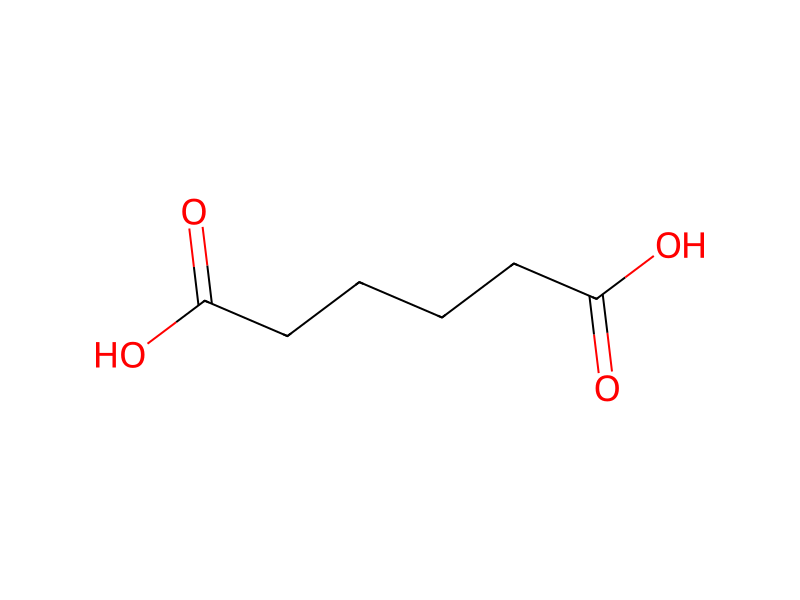
Procedure
According to the flow chart of FIG. 1, ε-caprolactone was produced. Initially, a crude reaction mixture A produced according to the procedure of Reference Example 1 was fed to a first distillation column and was subjected to distillation for removing low boiling components at a bottom temperature of 180° C. and a column top pressure of 90 mmHg (12.0 kPa). In the first distillation column, low boiling components including unreacted cyclohexanone ANO, unreacted peracetic acid, ethyl acetate and acetic acid were distilled as a first distillate A1 and a first side-cut fraction A2. The first side-cut fraction A2 contained ANO in a higher concentration than in the first overhead distillate A1. The first side-cut fraction A2 was introduced into a second distillation column, was subjected to distillation at a bottom temperature of 100° C. and a column top pressure of 225 mmHg (30.0 kPa) and thereby yielded a second distillate A21 containing unreacted peracetic acid, ethyl acetate, and acetic acid from the column top and a second bottom liquid A22 containing ANO and part of acetic acid from the bottom. The recovered second bottom liquid A22 was recycled as a reaction raw material to the reaction system. In the first distillation column, a first bottom liquid A3 containing the target ε-caprolactone CL-M, by-produced adipic acid ADA and a polymerization product of ε-caprolactone HB was recovered from the bottom. The recovered first bottom liquid A3 was introduced into a third distillation column and was subjected to distillation at a bottom temperature in a range from 120° C. to 200° C. and a column top pressure of 5 mmHg (0.67 kPa). In the third distillation column, the target ε-caprolactone was yielded as a third side-cut fraction A31 not from the column top but from an intermediate tray between the column top and a tray from which the first bottom liquid A3 was charged. A third bottom liquid A32 containing by-produced adipic acid ADA and a polymerized product of ε-caprolactone HB was drained from the bottom. Separately, a third overhead distillate A30 was recovered from the column top and was introduced into the first distillation column for removing low boiling components.
Workup
- customInitially, a crude reaction mixture A
- customproduced
- distillationwas fed to a first distillation column
- distillationwas subjected to distillation
- customfor removing low boiling components at a bottom temperature of 180° C.
- distillationIn the first distillation column, low boiling components
- distillationwere distilled as a first distillate A1
- concentrationin a higher concentration than in the first overhead distillate A1
- additionThe first side-cut fraction A2 was introduced into a second distillation column
- distillationwas subjected to distillation at a bottom temperature of 100° C.
- customa column top pressure of 225 mmHg (30.0 kPa) and thereby yielded a second distillate
- customThe recovered second bottom liquid A22 was recycled as a reaction raw material to the reaction system
- distillationIn the first distillation column
- additiona first bottom liquid A3 containing the target ε-caprolactone CL-M
Sources & evidence
- ORD record
- ord-e80cca5230d248ecb4535f00cd8e1367
- Source dataset
- uspto-grants-2005_08
- Patent number
- US06936724B2
Reaction notes
Loading…