1,4-Dibromobenzene → Benzene, 1-bromo-4-(2-propenyl)-
Reaction equation

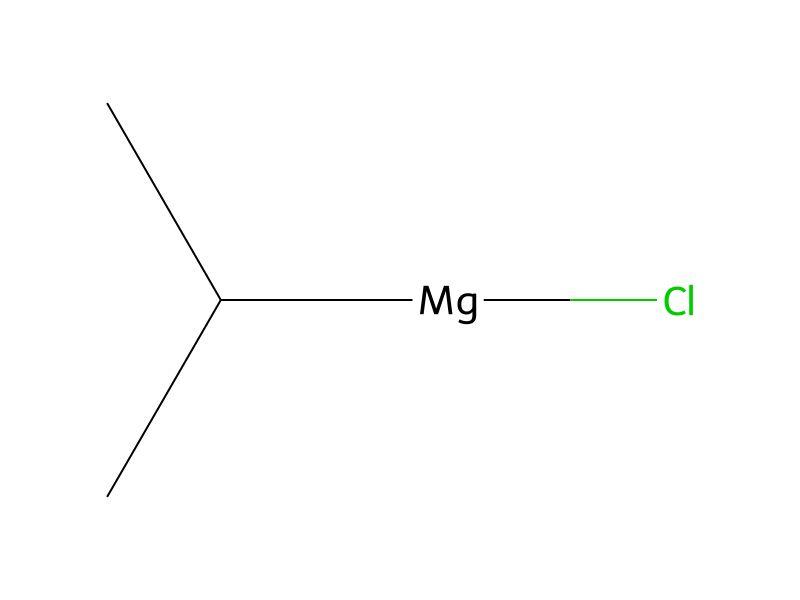
Br[C:2]1[CH:7]=[CH:6][C:5]([Br:8])=[CH:4][CH:3]=1.CO[CH:11]1[CH2:15]CC[CH2:12]1.C([Mg]Cl)(C)C.C([Li])CCC.C(Br)C=C.[Cl-].[NH4+]>C(OCC)C.CCCCCC.O1CCCC1>[CH2:15]([C:2]1[CH:7]=[CH:6][C:5]([Br:8])=[CH:4][CH:3]=1)[CH:11]=[CH2:12]Participants
Reactant 6





Product 1

Reagents, catalysts & solvents 3



Conditions
- Temperature
- -10 °C
Procedure
Under a nitrogen atmosphere, to 1,4-dibromobenzene (1) (15 g, 15.9 mmol), cyclopentyl methyl ether (CPME) (90 ml) was added and cooled to around −10° C. using salt ice, tetrahydrofuran (THF) solution (iPrMgCl solution) of 2M isopropyl magnesium chloride (0.35 equivalents, 11.2 ml) and hexane solution (nBuLi solution) of 1.67M normal-butyl lithium (0.7 equivalents, 26.8 ml) were added dropwise. The mixture was stirred for 2 hours at −10° C. Then allyl bromide (1.1 equivalents, 6.8 ml) was added and stirred at room temperature for 14 hours. To the reacted mixture, diethyl ether was added and neutralized by adding saturated ammonium chloride. The obtained water layer was extracted by diethyl ether. The collected organic layer was washed with saturated saline solution, dried over anhydrous magnesium sulfate, then filtered and concentrated under reduced pressure, obtaining a crude product of 1-allyl-4-bromobenzene (2) (yield: 13.0 g, yield (%): 103%)
Workup
- additionwere added dropwise
- stirringstirred at room temperature for 14 hours
- extractionThe obtained water layer was extracted by diethyl ether
- washThe collected organic layer was washed with saturated saline solution
- dry with materialdried over anhydrous magnesium sulfate
- filtrationfiltered
- concentrationconcentrated under reduced pressure
Sources & evidence
- ORD record
- ord-8294521537cc42d0beca956dfa39733d
- Source dataset
- uspto-grants-2016_01
- Patent number
- US09228107B2
Reaction notes
Loading…