Potassium Iodide → Benzyl 2-[4 benzyloxy-3-bromophenyl]acetate
Reaction equation

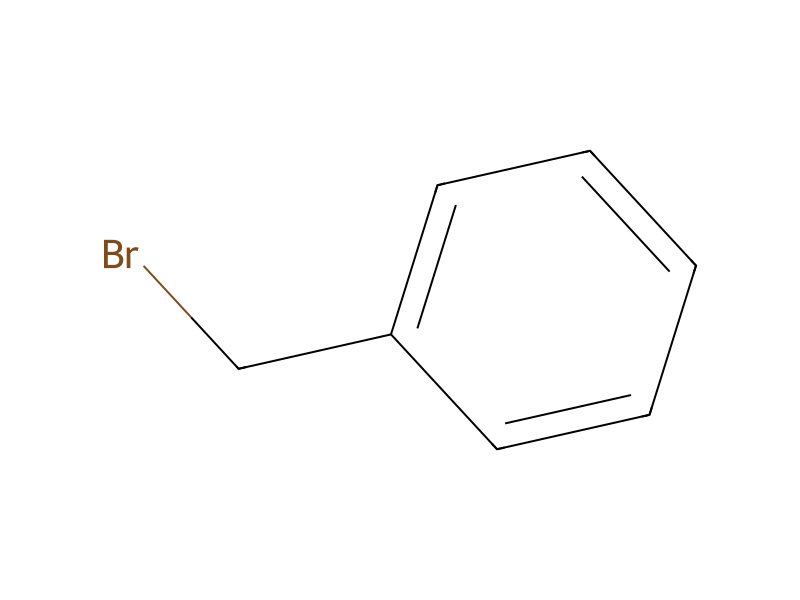
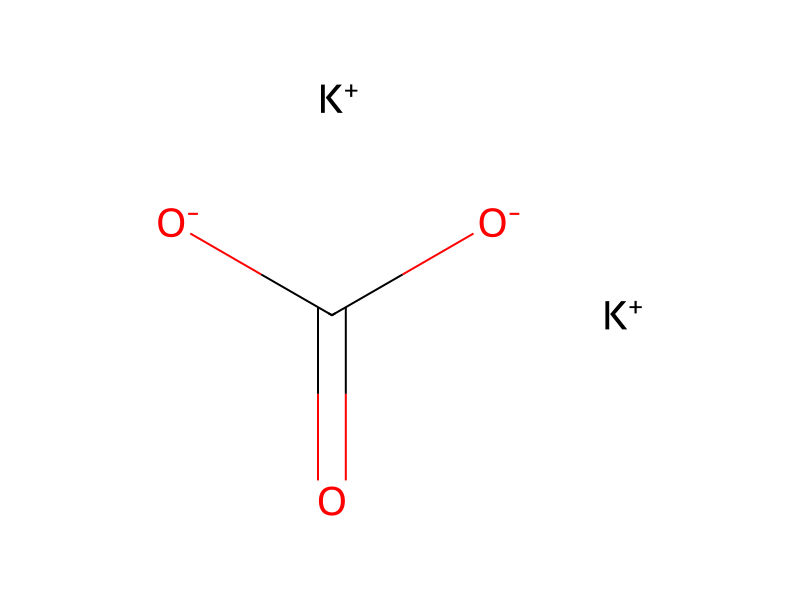
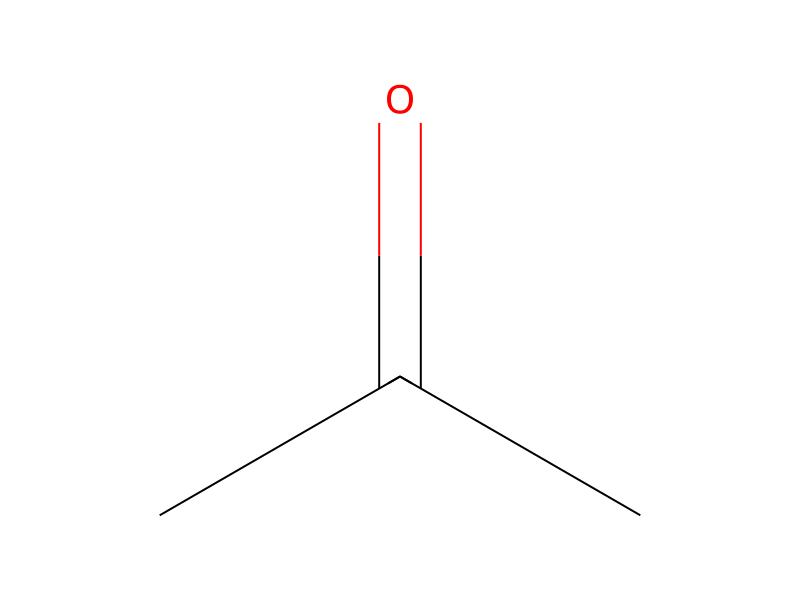
[Br:1][C:2]1[CH:3]=[C:4]([CH2:9][C:10]([OH:12])=[O:11])[CH:5]=[CH:6][C:7]=1[OH:8].C(=O)([O-])[O-].[K+].[K+].[I-].[K+].[CH2:21](Br)[C:22]1[CH:27]=[CH:26][CH:25]=[CH:24][CH:23]=1>CC(C)=O>[CH2:21]([O:8][C:7]1[CH:6]=[CH:5][C:4]([CH2:9][C:10]([O:12][CH2:9][C:4]2[CH:5]=[CH:6][CH:7]=[CH:2][CH:3]=2)=[O:11])=[CH:3][C:2]=1[Br:1])[C:22]1[CH:27]=[CH:26][CH:25]=[CH:24][CH:23]=1Participants



Procedure
A mixture of 2-[3-bromo-4-hydroxyphenyl]acetic acid (2.0 g, 8.7 mmol), potassium carbonate (3.7 g, 26.7 mmol) and potassium iodide (577 mg, 3.5 mmol) in acetone (25 mL) was treated with benzyl bromide (2.6 mL, 22.0 mmol), and the reaction was stirred at room temperature for 3 days. The reaction mixture was partitioned between ethyl acetate (100 mL) and 1M hydrochloric acid (100 mL); and the organic phase was then washed with saturated sodium hydrochloric acid (50 mL); dried over sodium sulfate; filtered and evaporated in vacuo to give the crude product. Purification on a Biotage™ SP1 system (40M silica; eluting with 0-50% ethyl acetate over 25CV) gave benzyl 2-[4-benzyloxy-3-bromophenyl]acetate (3.4 g, 94%) as a colourless oil. 1H NMR (400 MHz, CDCl3): δ 7.47-7.52 (m, 3H), 7.32-7.42 (m, 8H), 7.15 (d, J=8.2 Hz, 1H), 6.89 (d, J=8.4 Hz, 1H), 5.15 (s, 2H), 5.14 (s, 2H), 3.59 (s, 2H). Suzuki coupling of benzyl 2-[4-benzyloxy-3-bromophenyl]acetate (3.1 g, 7.5 mmol) according to standard protocol, gave benzyl (E)-2-[4-benzyloxy-3-[pent-1-enyl]phenyl]acetate (2.2 g, 72%). 1H NMR (400 MHz, CDCl3): δ 7.32-7.47 (m, 11H), 7.08 (dd, J=8.3, 2.2 Hz, 1H), 6.89 (d, J=8.4 Hz, 1H), 6.77 (d, J=16.0 Hz, 1H), 6.23 (dt, J=16.0, 7.0 Hz, 1H), 5.15 (s, 2H), 5.10 (s, 2H), 3.62 (s, 2H), 2.21 (tdd, J=7.2, 7.2, 1.4 Hz, 2H), 1.50 (qt, J=7.4, 7.2 Hz, 2H), 0.97 (t, J=7.4 Hz, 3H). A solution of the ester (2.2 g, 5.4 mmol) in ethyl acetate (20 mL) was then treated with palladium on carbon (10% w/w Pd; 215 mg). The mixture was thoroughly degassed in vacuo under hydrogen. The reaction was stirred at ambient temperature under one atmosphere of hydrogen for 17 h, then filtered through celite and evaporated in vacuo to give the crude product. Purification on a Biotage™ SP1 system (25M silica cartridge; eluting with 0-50% ethyl acetate over 30CV) gave 2-[4-hydroxy-3-pentylphenyl]acetic acid (1.1 g, 91%). 1H NMR (400 MHz, CDCl3): δ 7.02 (d, J=2.3 Hz, 1H), 6.97 (dd, J=8.1, 2.2 Hz, 1H), 6.63 (d, J=8.0 Hz, 1H), 3.34 (s, 2H), 2.53 (t, J=7.8 Hz, 2H), 1.56-1.63 (m, 2H), 1.31-1.37 (m, 4H), 0.89 (t, J=7.0 Hz, 3H); 13C NMR (101 MHz, CDCl3): δ 178.60, 153.19, 131.34, 129.40, 127.98, 125.32, 115.61, 40.55, 32.01, 30.17, 29.64, 22.80, 14.29. The resulting acid (1.1 g, 5.1 mmol) was then converted to the sodium salt by standard protocol, to give sodium 2-[4-hydroxy-3-pentylphenyl]acetate (1.3 g, quantitative yield) as a white solid. mp 193-197° C.; 1H NMR (400 MHz, CD3OD): δ 7.01 (d, J=2.0 Hz, 1H), 6.93 (dd, J=8.1, 2.3 Hz, 1H), 6.71 (d, J=8.0 Hz, 1H), 3.55 (s, 2H), 2.56 (t, J=7.8 Hz, 2H), 1.54-1.59 (m, 2H), 1.28-1.38 (m, 4H), 0.90 (t, J=7.0 Hz, 3H); 13C NMR (101 MHz, CD3OD): δ 180.18, 153.17, 130.54, 128.83, 128.74, 127.08, 114.45, 44.44, 31.83, 30.08, 29.72, 22.51, 13.28; LRMS (ESI): m/z 445.6 (2M−2Na++3H+), 223.2 (M-Na++2H+), 177.2 (tropylium ion); HPLC: 2.2 min.
Workup
- customThe reaction mixture was partitioned between ethyl acetate (100 mL) and 1M hydrochloric acid (100 mL)
- washand the organic phase was then washed with saturated sodium hydrochloric acid (50 mL)
- dry with materialdried over sodium sulfate
- filtrationfiltered
- customevaporated in vacuo
- customto give the crude product
- customPurification on a Biotage™ SP1 system (40M silica
- washeluting with 0-50% ethyl acetate over 25CV)
Sources & evidence
- ORD record
- ord-fbd07fee14ff4bc7b7bacbbb05ce6505
- Source dataset
- uspto-grants-2016_09
- Patent number
- US09439882B2
Reaction notes
Loading…