Hydrochloric Acid → (S)-6-Chloro-4-(5-(2-methylpiperazin-1-yl)pyridin-2-ylamino)pyridazin-3(2H)-one
Reaction equation
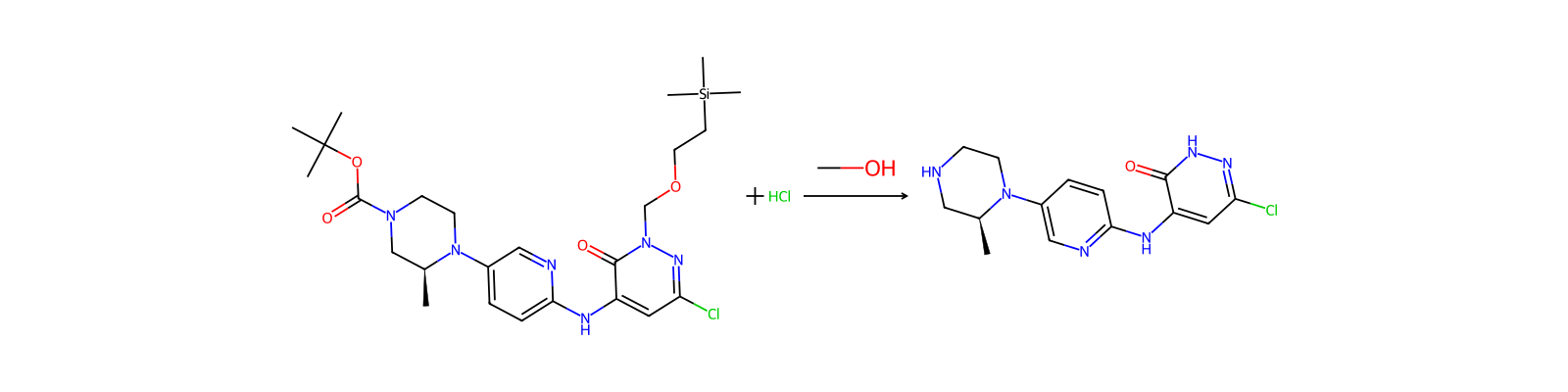
[Cl:1][C:2]1[CH:3]=[C:4]([NH:17][C:18]2[N:23]=[CH:22][C:21]([N:24]3[CH2:29][CH2:28][N:27](C(OC(C)(C)C)=O)[CH2:26][C@@H:25]3[CH3:37])=[CH:20][CH:19]=2)[C:5](=[O:16])[N:6](COCC[Si](C)(C)C)[N:7]=1.Cl>CO>[Cl:1][C:2]1[CH:3]=[C:4]([NH:17][C:18]2[CH:19]=[CH:20][C:21]([N:24]3[CH2:29][CH2:28][NH:27][CH2:26][C@@H:25]3[CH3:37])=[CH:22][N:23]=2)[C:5](=[O:16])[NH:6][N:7]=1Participants
4
Reactant 2


Product 1

Reagents, catalysts & solvents 1

Procedure
A 50-mL round-bottomed flask was charged with 253b (551 mg, 1.0 mmol), concentrated HCl (2 mL), and methanol (10 mL). The mixture was stirred at room temperature overnight. It was then concentrated under reduced pressure to afford 253c, which was used directly in the next step without further purification. MS-ESI: [M+H]+ 321.1
Workup
- concentrationIt was then concentrated under reduced pressure
Sources & evidence
- ORD record
- ord-36dd74ff83d24cac9fa577c5200e714c
- Source dataset
- uspto-grants-2016_01
- Patent number
- US09238655B2
Reaction notes
Loading…