Triethylamine → Methanesulfonic acid 2-tert-butoxycarbonylamino-2-methyl-propyl ester
Reaction equation
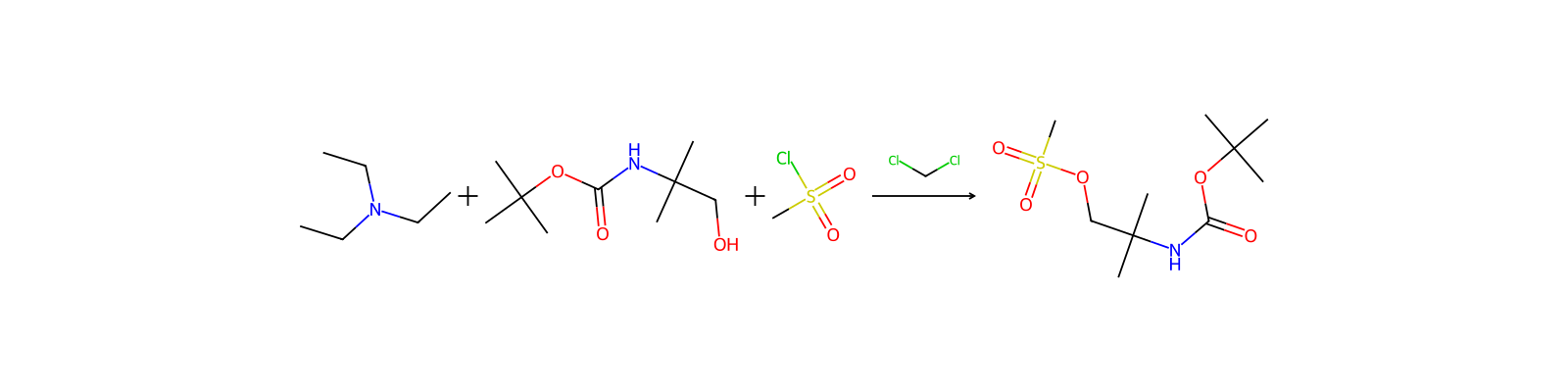
C(N(CC)CC)C.[OH:8][CH2:9][C:10]([NH:13][C:14](=[O:20])[O:15][C:16]([CH3:19])([CH3:18])[CH3:17])([CH3:12])[CH3:11].[CH3:21][S:22](Cl)(=[O:24])=[O:23]>ClCCl>[CH3:21][S:22]([O:8][CH2:9][C:10]([NH:13][C:14]([O:15][C:16]([CH3:19])([CH3:18])[CH3:17])=[O:20])([CH3:11])[CH3:12])(=[O:24])=[O:23]Participants




Conditions
- Temperature
- 0 °C
Procedure
Dichloromethane (50 mL) and triethylamine (9.72 ml, 69.7 mmol) were added to a flask containing tert-butyl (1-hydroxy-2-methylpropan-2-yl)carbamate (3.30 g, 17.4 mmol). The reaction mixture was stirred and then chilled to 0° C. for 10 minutes. Methanesulfonyl chloride (2.72 ml, 34.9 mmol) was dissolved in dichloromethane (15 mL) and slowly added to the reaction mixture, which was then allowed to stir at 0° C. for 2 hours. The reaction was quenched with saturated aqueous sodium bicarbonate solution and the organic layer was separated. The organic layer was dried over anhydrous sodium sulfate, filtered, and concentrated under reduced pressure to afford 2-((tert-butoxycarbonyl)amino)-2-methylpropyl methanesulfonate. 1H NMR (500 MHz, DMSO-d6): δ 6.73 (s, 1H), 4.20 (s, 2H), 3.12 (s, 3H), 1.36 (s, 9H), 1.17 (s, 6H).
Workup
- additionslowly added to the reaction mixture, which
- stirringto stir at 0° C. for 2 hours
- customThe reaction was quenched with saturated aqueous sodium bicarbonate solution
- customthe organic layer was separated
- dry with materialThe organic layer was dried over anhydrous sodium sulfate
- filtrationfiltered
- concentrationconcentrated under reduced pressure
Sources & evidence
- ORD record
- ord-28b01ec3569a49af8748445519917d4d
- Source dataset
- uspto-grants-2016_01
- Patent number
- US09242984B2
Reaction notes
Loading…