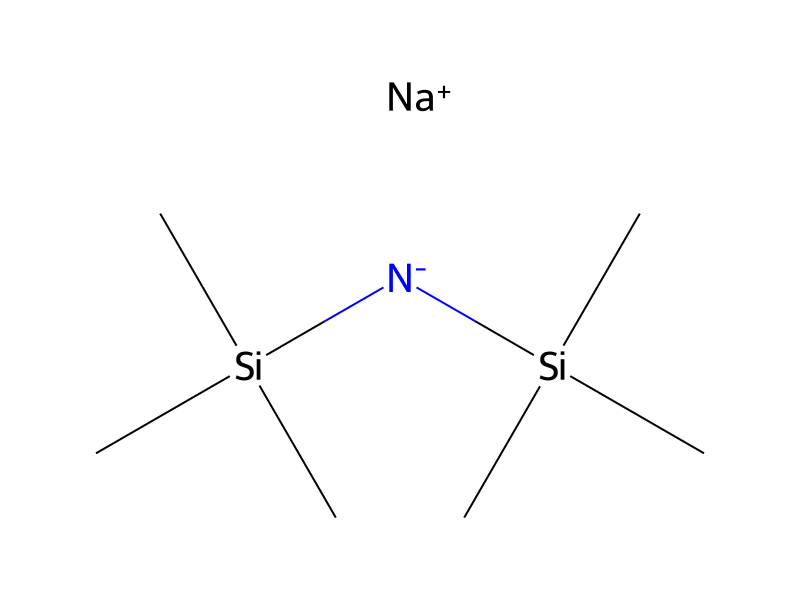
Sodium bis(trimethylsilyl)amide → HCID 131734618, compound
Reaction equation

Br[C:2]1[CH:7]=[N:6][C:5]([N:8]2[C:12]([CH3:13])=[CH:11][CH:10]=[C:9]2[CH3:14])=[CH:4][N:3]=1.[Si:15]([O:22][C@H:23]1[CH2:28][CH2:27][C@@H:26]([C:29]([O:31][CH2:32][CH3:33])=[O:30])[CH2:25][C@@H:24]1[F:34])([C:18]([CH3:21])([CH3:20])[CH3:19])([CH3:17])[CH3:16].C[Si]([N-][Si](C)(C)C)(C)C.[Na+]>C1(C)C=CC=CC=1>[Si:15]([O:22][C@H:23]1[CH2:28][CH2:27][C:26]([C:2]2[CH:7]=[N:6][C:5]([N:8]3[C:12]([CH3:13])=[CH:11][CH:10]=[C:9]3[CH3:14])=[CH:4][N:3]=2)([C:29]([O:31][CH2:32][CH3:33])=[O:30])[CH2:25][C@@H:24]1[F:34])([C:18]([CH3:21])([CH3:20])[CH3:19])([CH3:17])[CH3:16]Participants
Reactant 3


Product 1

Reagents, catalysts & solvents 1

Conditions
- Temperature
- -35 °C
Procedure
To a 1 L flask was added 2-bromo-5-(2,5-dimethyl-1H-pyrrol-1-yl)pyrazine (23 g, 67 mmol), (1R,3S,4S)-ethyl 4-((tert-butyldimethylsilyl)oxy)-3-fluorocyclohexanecarboxylate (28 g, 83 mmol), {[P(t-Bu)3]PdBr}2 (800 mg, 1 mmol) followed by toluene (250 mL). The reaction mixture was degassed three times by purging with nitrogen and then cooled to −35±5° C. To the reaction mixture was added NaHMDS (47 mL, 2 M in THF, 94 mmol), dropwise. The temperature was raised to room temeperature over a one hour period and stirred for a further 30 minutes. The reaction mixture was quenched with 8% aqueous ammonium chloride (200 mL), the phases separated, and the aqueous layer extracted with heptane (300 mL). The combined organic layer was washed with 10% brine (400 mL), concentrated under reduced pressure(45±5° C., 50˜100 mbar) to give 48 g of (1RS,3S,4S)-ethyl 4-((tert-butyldimethylsilyl)oxy)-1-(5-(2,5-dimethyl-1H-pyrrol-1-yl)pyrazin-2-yl)-3-fluorocyclohexanecarboxylate as a mixture of 1R and 1S diastereomers. This material was used for next step without further purification. HPLC retention time=8.274 min HPLC method d: Instrument: Agilent Technologies 1200 series. Column: Waters Xbridge C18, 150*3.0 mm, 3 um. Column temperature: 35° C. Flow rate: 0.70 mL/min. Detection: 210 nm/DAD. Mobile phase composition: A: 0.1% H3PO4 in water; B: acetonitrile. Gradient: 0 min: 90% A, 10% B; 5 min: 100% B; 11 min 100% B. LC-MS method: [M+H]+=476.2706, 1H NMR (400 MHz, DMSO-d6): 8.47 (s. 1H), 8.43 (s, 1H), 5.85 (s, 2H), 4.39˜4.52 (m, 1H), 4.14 (dd, J=12 Hz, J=8 Hz, 2H), 3.59˜3.66 (m, 1H), 2.28˜2.94 (m, 1H), 2.06 (s, 6H), 1.84˜1.97 (m, 3H), 1.46˜1.52 (m, 3H), 1.14˜1.17 (t, J=12 Hz, J=8 Hz, 2H), 0.81 (s, 9H), 0.01 (d, J=4 Hz, 6H).
Workup
- customThe reaction mixture was degassed three times
- customby purging with nitrogen
- temperatureThe temperature was raised to room temeperature over a one hour period
- customThe reaction mixture was quenched with 8% aqueous ammonium chloride (200 mL)
- customthe phases separated
- extractionthe aqueous layer extracted with heptane (300 mL)
- washThe combined organic layer was washed with 10% brine (400 mL)
- concentrationconcentrated under reduced pressure(45±5° C., 50˜100 mbar)
Sources & evidence
- ORD record
- ord-71ab367fcb4b41db9f1698af356354dc
- Source dataset
- uspto-grants-2016_01
- Patent number
- US09242996B2
Reaction notes
Loading…