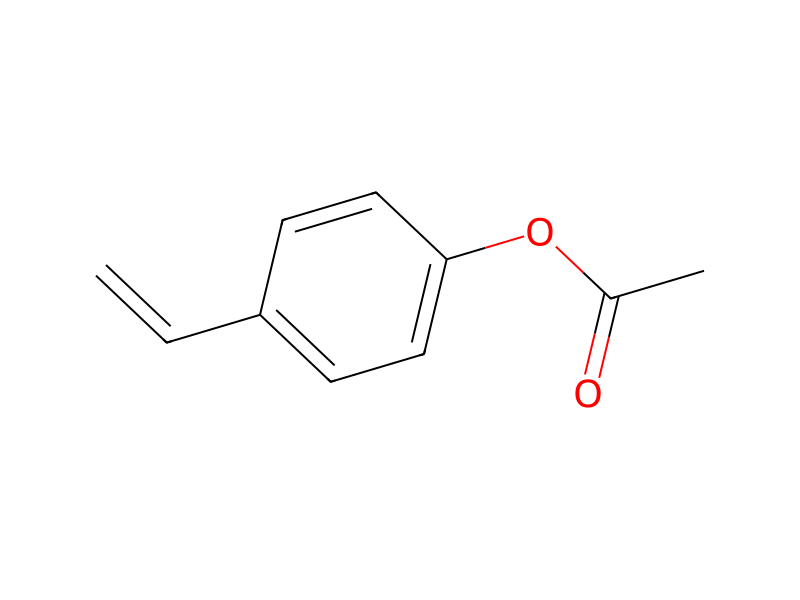
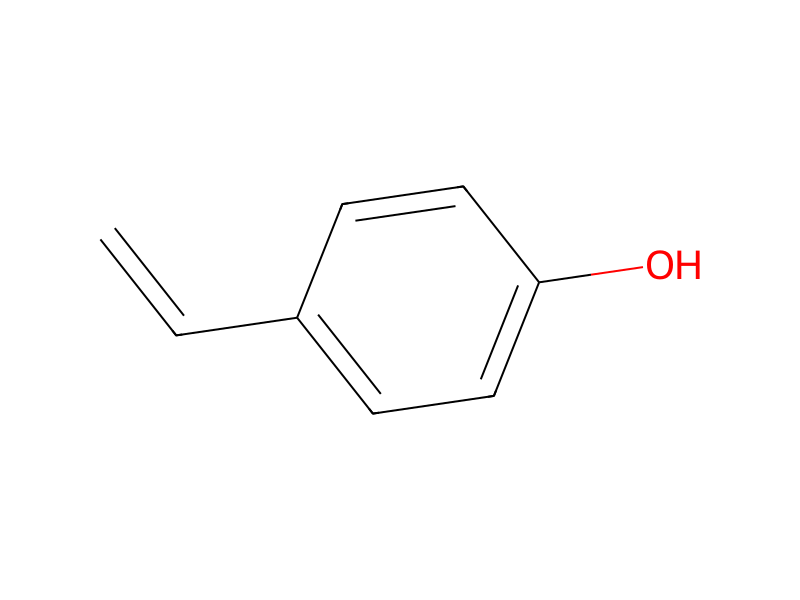
4-Ethenylphenyl acetate → 4-Vinylphenol
Reaction equation

C([O:4][C:5]1[CH:12]=[CH:11][C:8]([CH:9]=[CH2:10])=[CH:7][CH:6]=1)(=O)C>O1CCCC1.CCCCCCC>[OH:4][C:5]1[CH:12]=[CH:11][C:8]([CH:9]=[CH2:10])=[CH:7][CH:6]=1Participants
Reactant 2

Product 1
Reagents, catalysts & solvents 1

Procedure
Separately, a polyethylene film having a thickness of 0.1 mm was inserted into a glass ampoule, and subsequently, a tetrahydrofuran-n-heptane mixed solution (1:2 by volume) containing 20 wt% of p-acetoxystyrene monomer was added thereto, followed by heat-sealing the glass ampoule in vacuum. After irradiation of γ-rays of 105 rad/hr at a temperature of 25° C for 10 hours, the resulting film was taken out of the glass ampoule and sufficiently washed with acetone to remove the p-acetoxystyrene homopolymer. The thus treated film was then refluxed in a concentrated hydrochloric acid-methanol mixed solution (1:4 by volume) under heating for a period of 30 minutes, followed by hydrolysis to obtain a film in which a p-hydroxystyrene side chain was grafted at a grafting ratio of 52 wt% (based on the polyethylene). This film was further immersed in concentrated sulfuric acid at a temperature of 25° C for 72 hours and then sulfonated to obtain a cationic exchange membrane. The thus obtained cationic exchange membrane was used as a diaphragm. To the cationic exchange membrane to be used as a diaphragm was subjected a pre-treatment in which the membrane was immersed in a 0.5N sodium hydroxide aqueous solution at a temperature of 80° C for a period of 2 hours prior to the electrolysis. This cationic exchange membrane had a cation transport number of 0.97, an electric resistance, in 0.5N sodium chloride, of 1.7 Ω-cm2, and an acidic ion-exchange capacity of 2.2 meq/g. A current of 1.0 A (10 A/dm2) was passed for 5 hours. It was found that the concentration of sodium hydroxide in the catholyte was 16.8& by weight, that the concentration of sodium chloride was 0.02% by weight, and that the current efficiency was 83%.
Workup
- additionwas added
- temperatureby heat-sealing the glass ampoule in vacuum
- customAfter irradiation of γ-rays of 105 rad/hr at a temperature of 25° C for 10 hours
- washsufficiently washed with acetone
- customto remove the p-acetoxystyrene homopolymer
- temperatureThe thus treated film was then refluxed in a concentrated hydrochloric acid-methanol mixed solution (1:4 by volume)
- temperatureunder heating for a period of 30 minutes
- customfollowed by hydrolysis
Sources & evidence
- ORD record
- ord-7a45582deb1344b3912432a2eb3ca05c
- Source dataset
- uspto-grants-1977_03
- Patent number
- US04011147
Reaction notes
Loading…