Ethanol → 6-(1H-pyrazol-4-yl)isoquinoline
Reaction equation

Br[C:2]1[CH:3]=[C:4]2[C:9](=[CH:10][CH:11]=1)[CH:8]=[N:7][CH:6]=[CH:5]2.[NH:12]1[CH:16]=[C:15](B2OC(C)(C)C(C)(C)O2)[CH:14]=[N:13]1.C(=O)([O-])[O-].[Na+].[Na+].CCO>COCCOC.C([O-])(O)=O.[Na+].Cl[Pd](Cl)([P](C1C=CC=CC=1)(C1C=CC=CC=1)C1C=CC=CC=1)[P](C1C=CC=CC=1)(C1C=CC=CC=1)C1C=CC=CC=1.O>[NH:12]1[CH:16]=[C:15]([C:2]2[CH:3]=[C:4]3[C:9](=[CH:10][CH:11]=2)[CH:8]=[N:7][CH:6]=[CH:5]3)[CH:14]=[N:13]1Participants
Reactant 4



Product 1

Reagents, catalysts & solvents 4




Procedure
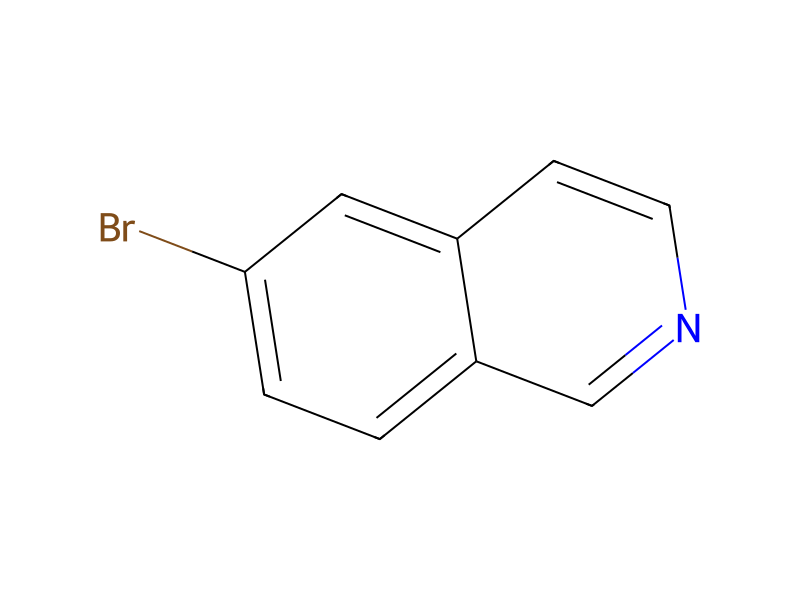
A mixture of 6-bromoisoquinoline (500 mg, 2.40 mmol) (commercially available from Kalexsyn Product List (Order Number 2003-005)), pyrazole-4-boronic acid pinacol ester (560 mg, 2.88 mmol) (commercially available from Acros Organics (Order Number 38294)), trans-dichlorobis(triphenylphosphine)palladium(II) (118 mg, 0.17 mmol), and sodium carbonate (764 mg, 7.21 mmol) in DME:EtOH:H2O=7:2:3 (4 mL) was heated at 140° C. for 10 minutes in a Biotage Initiator® microwave. After cooling to room temperature, the mixture was diluted with saturated aqueous NaHCO3 and extracted with 25% i-PrOH/CHCl3 (3×). The combined organic layers were dried over Na2SO4, filtered and adsorbed onto silica gel. The residue was purified using column chromatography (acetone/hexanes=0-50%) to provide the product as an off-white solid (177 mg, 37%). LCMS (API-ES) m/z: 196 (M+H+).
Workup
- extractionextracted with 25% i-PrOH/CHCl3 (3×)
- dry with materialThe combined organic layers were dried over Na2SO4
- filtrationfiltered
- customThe residue was purified
Sources & evidence
- ORD record
- ord-8faf3a660eaf4decbe9ca28c5bc40927
- Source dataset
- uspto-grants-2011_03
- Patent number
- US07897619B2
Reaction notes
Loading…