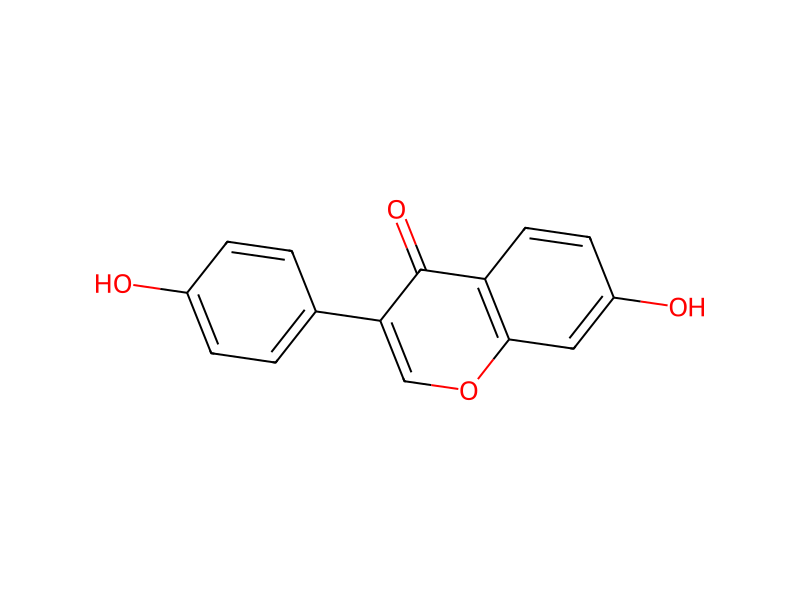
Water → Daidzein diacetate
Reaction equation

[CH:1]1[C:6]([C:7]2[C:16](=[O:17])[C:15]3[CH:14]=[CH:13][C:12]([OH:18])=[CH:11][C:10]=3[O:9][CH:8]=2)=[CH:5][CH:4]=[C:3]([OH:19])[CH:2]=1.[C:20](OC(=O)C)(=[O:22])[CH3:21].N1[CH:32]=[CH:31]C=CC=1.[OH2:33]>>[CH3:21][C:20]([O:19][C:3]1[CH:4]=[CH:5][C:6]([C:7]2[C:16](=[O:17])[C:15]3[CH:14]=[CH:13][C:12]([O:18][C:31]([CH3:32])=[O:33])=[CH:11][C:10]=3[O:9][CH:8]=2)=[CH:1][CH:2]=1)=[O:22]Participants
5




Procedure
A mixture of daidzein (1.0 g, 3.9 mmol), acetic anhydride (5 ml) and pyridine (5 ml) was left in the dark at room temperature for 24 h. The reaction mixture was poured into water (100 ml), stirred for 2 h and then extracted with dichloromethane (3×50 ml). The dichloromethane layer was washed with water, dried over anhydrous sodium sulfate and evaporated. The white residue was crystallised from methanol to yield daidzein diacetate as white prisms (1.1 g, 83%). 1H NMR (CDCl3): δ 2.32 (s, 3H, OCOCH3), 2.36 (s, 3H, OCOCH3), 7.18 (d, 2H, J 9.2 Hz, ArH), 7.19 (d, 1H, J 9.0 Hz, H6), 7.31 (d, 1H, J 2.0 Hz H8), 7.59 (d, 2H, J 9.2 Hz, ArH), 8.00 (s, 1H, H2), 8.33 (d, 2H, J 8.2 Hz, ArH).
Workup
- extractionextracted with dichloromethane (3×50 ml)
- washThe dichloromethane layer was washed with water
- dry with materialdried over anhydrous sodium sulfate
- customevaporated
- customThe white residue was crystallised from methanol
Sources & evidence
- ORD record
- ord-e487187fc73b4ec0b3464b1a35b8712d
- Source dataset
- uspto-grants-2011_03
- Patent number
- US07906660B2
Reaction notes
Loading…