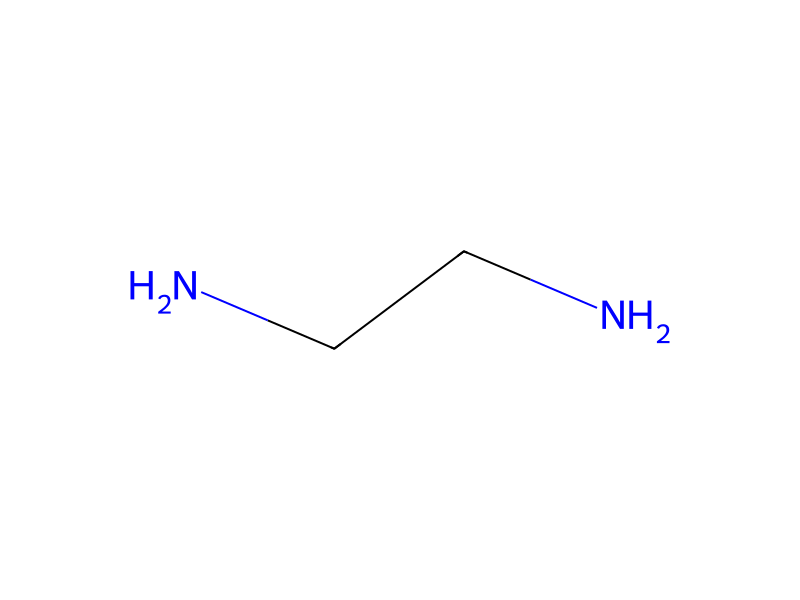
Ethylenediamine → N-(2-chloro-3-nitroquinolin-4-yl)ethane-1,2-diamine
Reaction equation

[NH2:1][CH2:2][CH2:3][NH2:4].[Cl:5][C:6]1[C:15]([N+:16]([O-:18])=[O:17])=[C:14](Cl)[C:13]2[C:8](=[CH:9][CH:10]=[CH:11][CH:12]=2)[N:7]=1.C(N(CC)CC)C>ClCCl>[Cl:5][C:6]1[C:15]([N+:16]([O-:18])=[O:17])=[C:14]([NH:1][CH2:2][CH2:3][NH2:4])[C:13]2[C:8](=[CH:9][CH:10]=[CH:11][CH:12]=2)[N:7]=1Participants
Reactant 3


Product 1

Reagents, catalysts & solvents 1

Procedure
1,2-Diaminoethane (7.55 mL, 113 mmol) was added to a 0° C. solution of 2,4-dichloro-3-nitroquinoline (28.9 g, 119 mmol) and triethylamine (24.9 mL, 179 mmol) in dichloromethane (600 mL). The solution was allowed to warm slowly to room temperature and stir for 20 hours. The solvent was removed under reduced pressure and 5% aqueous Na2CO3 (300 mL) was added. The resulting slurry was stirred vigorously at 0° C. for four hours. A yellow solid was isolated by vacuum filtration and dried under vacuum. The solid was purified by suction filter chromatography (silica gel, gradient elution from 98:2 to 93:7 dichloromethane/methanol) to provide the product N-(2-chloro-3-nitroquinolin-4-yl)ethane-1,2-diamine (16.0 g) that contained a small amount of an impurity.
Workup
- customThe solvent was removed under reduced pressure and 5% aqueous Na2CO3 (300 mL)
- additionwas added
- stirringThe resulting slurry was stirred vigorously at 0° C. for four hours
- customA yellow solid was isolated by vacuum filtration
- customdried under vacuum
- customThe solid was purified by suction
- filtrationfilter
- washchromatography (silica gel, gradient elution from 98:2 to 93:7 dichloromethane/methanol)
Sources & evidence
- ORD record
- ord-313c2d9b55b141e5a5fec001edb323da
- Source dataset
- uspto-grants-2011_03
- Patent number
- US07915281B2
Reaction notes
Loading…