HCID 67516649, compound → 7-Chloro-1,2,3,4-tetrahydroisoquinoline-3-carboxylic acid hydrochloride
Reaction equation
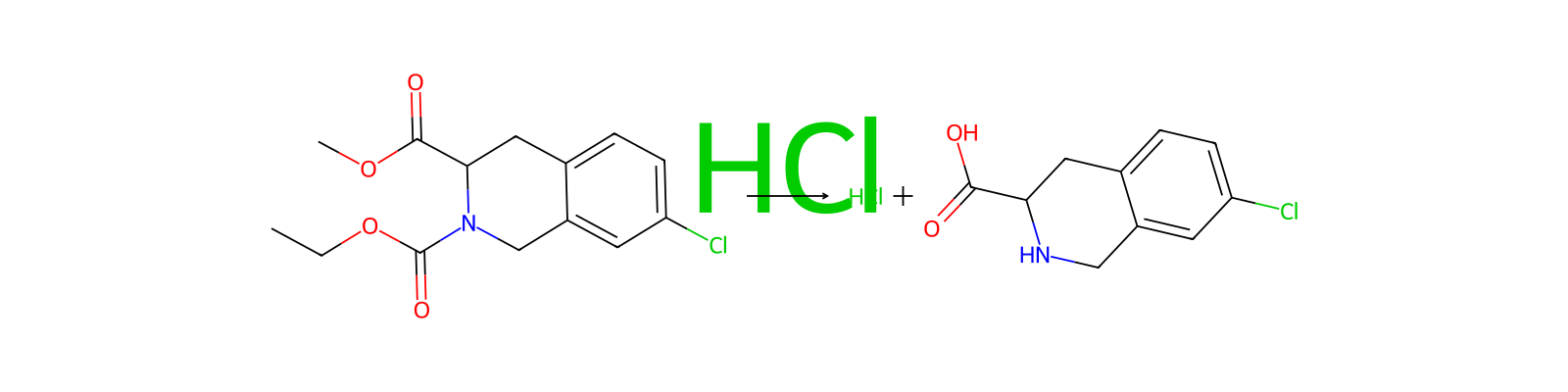
[Cl:1][C:2]1[CH:11]=[C:10]2[C:5]([CH2:6][CH:7]([C:17]([O:19]C)=[O:18])[N:8](C(OCC)=O)[CH2:9]2)=[CH:4][CH:3]=1>Cl>[ClH:1].[Cl:1][C:2]1[CH:11]=[C:10]2[C:5]([CH2:6][CH:7]([C:17]([OH:19])=[O:18])[NH:8][CH2:9]2)=[CH:4][CH:3]=1Participants
Reactant 1

Product 1

Reagents, catalysts & solvents 1

Conditions
- Temperature
- 102.5 °C
Procedure
A mixture of 2-ethyl 3-methyl 7-chloro-3,4-dihydroisoquinoline-2,3(1H)-dicarboxylate (2.19 g, 7.36 mmol) in 6 M aqueous HCl (30 mL) was heated to 100-105° C. for 2 days. The resulting mixture was concentrated under reduced pressure and triturated with toluene (2×100 mL). Once the supernatant was removed, the solid residue was dried under high vacuum to give 7-chloro-1,2,3,4-tetrahydroisoquinoline-3-carboxylic acid hydrochloride (1.71 g, 94%) as a faint yellow solid which was used in the next step without further purification. 1H NMR (DMSO-d6, 400 MHz) δ 14.2 (bs, ˜1 H), 10.0 (bs, ˜2 H), 7.41 (s, 1 H), 7.32 (m, 2 H), 4.40 (m, 1H), 4.32 (m, 2 H), 3.32 (dd, J=17, 4.9 Hz, 1 H), 3.10 (dd, J=17, 11 Hz). LC-MS gives ESI+MS found for C10H10ClNO2 m/z 212.1 (M+H).
Workup
- concentrationThe resulting mixture was concentrated under reduced pressure
- customtriturated with toluene (2×100 mL)
- customOnce the supernatant was removed
- customthe solid residue was dried under high vacuum
Sources & evidence
- ORD record
- ord-a550d74b993044a6a2e73e01bdf7206e
- Source dataset
- uspto-grants-2016_09
- Patent number
- US09440995B2
Reaction notes
Loading…