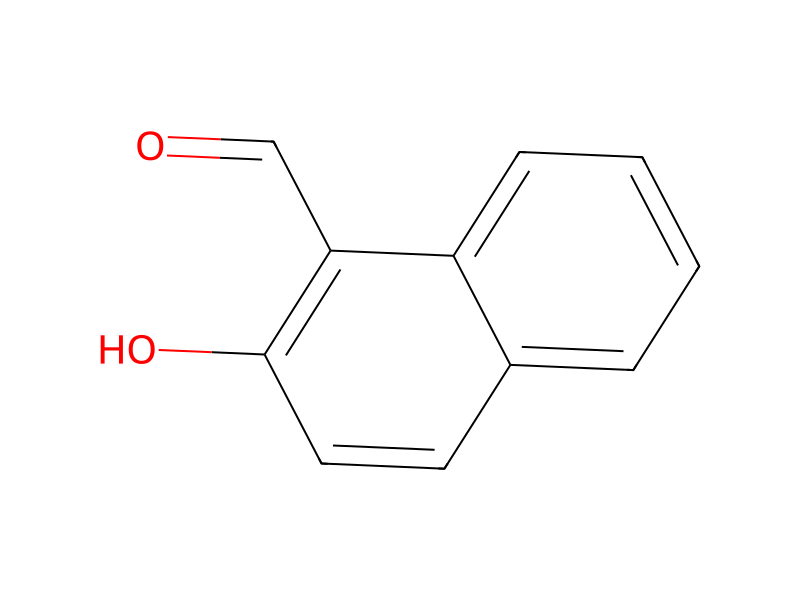
Ethanol → 2-Hydroxy-1-naphthaldehyde
Reaction equation

[CH:1]1[C:10]2[C:5](=[CH:6][CH:7]=[CH:8][CH:9]=2)[CH:4]=[CH:3][C:2]=1[OH:11].CO.[CH2:14]([OH:16])C.C(Cl)(Cl)Cl>O.C(Cl)(Cl)Cl>[OH:11][C:2]1[CH:3]=[CH:4][C:5]2[C:10](=[CH:9][CH:8]=[CH:7][CH:6]=2)[C:1]=1[CH:14]=[O:16]Participants
Reactant 4




Product 1
Reagents, catalysts & solvents 2

Procedure
In step (a), β-naphthol is preferably first added to an aqueous alcoholic alkaline medium, for instance a solution of an alkali metal hydroxide in a mixture of water and a C1-C4 aliphatic alcohol, especially methanol or ethanol, at an elevated temperature preferably at a temperature within the range of 70°-100° C. To the resulting pale brown emulsion, the chloroform reactant is then added slowly -- preferably dropwise -- at an elevated temperature, preferably 70°-100° C. After the addition of a few drops of chloroform, the reaction mixture assumes a blue colouration which is allowed to change to green before any further chloroform is added. Subsequently, chloroform is added slowly and at such a rate that the green colouration is maintained. After completion of the addition of chloroform, the alkali metal salt of 2-hydroxy-1-naphthaldehyde may be isolated e.g. by filtration, and washed, preferably with brine.
Workup
- customwithin the range of 70°-100° C
- customat an elevated temperature, preferably 70°-100° C
- additionis added
- temperatureat such a rate that the green colouration is maintained
Sources & evidence
- ORD record
- ord-794d039d768b444aba21aff91d5daf14
- Source dataset
- uspto-grants-1979_03
- Patent number
- US04143058
Reaction notes
Loading…