Ethylene Glycol → 1,4-Dioxaspiro(4.5)decan-8-ol
Reaction equation

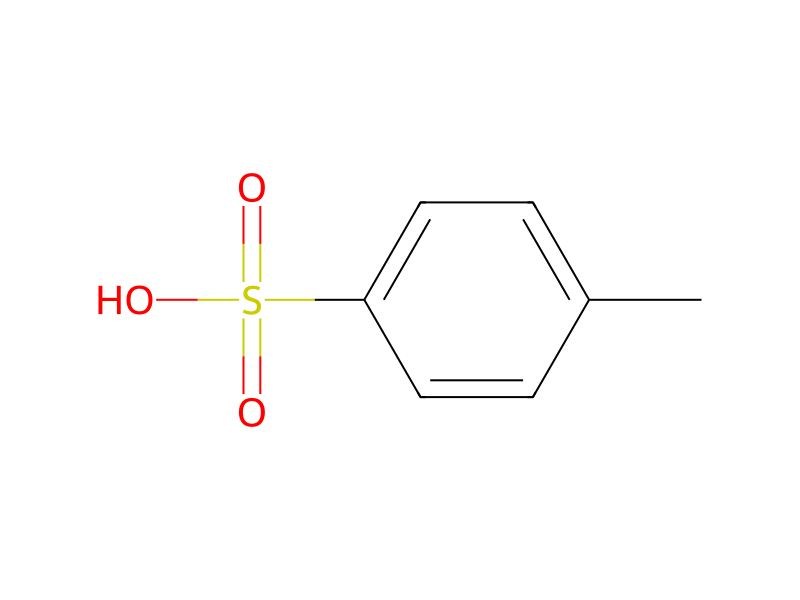
[OH:1][CH:2]1[CH2:7][CH2:6][C:5](=[O:8])[CH2:4][CH2:3]1.[CH2:9](O)[CH2:10][OH:11].C1(C)C=CC(S(O)(=O)=O)=CC=1>C1C=CC=CC=1>[CH2:10]1[O:11][C:5]2([CH2:6][CH2:7][CH:2]([OH:1])[CH2:3][CH2:4]2)[O:8][CH2:9]1Participants
Reactant 3


Product 1

Reagents, catalysts & solvents 1

Procedure
A reaction mixture consisting of 10 g. (0.085 mole) 4-hydroxycyclohexanone, 4.75 ml. ethylene glycol, 0.20 g. p-toluenesulfonic acid, and 100 ml. benzene is heated at the reflux temperature in a reaction vessel fitted with a Dean and Stark trap for 2 hours. After the reaction mixture has cooled, it is washed first with water and then with brine. The benzene is then removed by evaporation under reduced pressure giving the intermediate 4-hydroxycyclohexanone ethylene monoketal as a viscous oil weighing 14.12 g. The 4-hydroxycyclohexanone ethylene monoketal is dissolved in 100 ml. methylene chloride and added with stirring to a suspension consisting of 55.0 g. chromium trioxide (pre-dried for 24 hours under reduced pressure over phosphorous pentoxide), one liter dry methylene chloride, and 52.8 g. 3,5-dimethylpyrazole. After continued stirring for ten (10) minutes, this dark reaction mixture is poured onto a two-liter column of silica gel. When the reaction mixture has been completely adsorbed, the chromatogram is developed with a 1:1 mixture of ethyl acetate and technical hexane (Skellysolve B -- a mixture of isomeric hexanes having a boiling range between 60° and 70° C.). The appropriate fractions as determined by TLC are collected and combined, after which the solvents are removed by evaporation under reduced pressure. The crystals thus obtained are recrystallized from technical hexane, and there is thus obtained 10.82 g. (91% yield) of the desired cyclohexane - 1,4-dione, ethylene monoketal having a melting point at 68° to 69° C. [The literature value is 71.5° to 72.5° C.]
Workup
- customfitted with a Dean and Stark trap for 2 hours
- temperatureAfter the reaction mixture has cooled
- washit is washed first with water
- customThe benzene is then removed by evaporation under reduced pressure
Sources & evidence
- ORD record
- ord-f9855bdb73964457a46045c747a71043
- Source dataset
- uspto-grants-1979_03
- Patent number
- US04143156
Reaction notes
Loading…