Hydrogen Peroxide → Sodium percarbonate
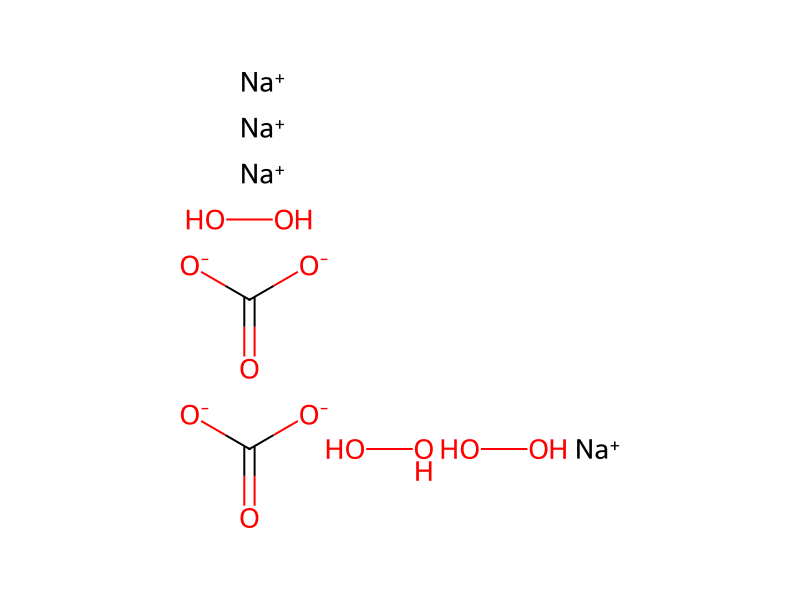
Reaction equation

[OH:1][OH:2].[C:3]([O:6][O-:7])([O-:5])=[O:4].[Na+:8].[Cl-].[Na+]>>[C:3]([O-:6])([O-:5])=[O:4].[C:3]([O-:6])([O-:5])=[O:4].[OH:1][OH:2].[OH:6][OH:7].[OH:6][OH:7].[Na+:8].[Na+:8].[Na+:8].[Na+:8]Participants
4



Procedure
According to British Pat. No. 549,841, sodium percarbonate is produced by reacting sodium silicate or a magnesium salt in the presence of an alkali metaphosphate or an alkali pyrophosphate to obtain soda decahydrate crystals or a suspension of the decahydrate in a saturated soda solution in a reaction with a hydrogen peroxide solution. The solubility of the percarbonate is reduced by the subsequent addition of sodium chloride. This product, however, also has an unsatisfactory grain size distribution curve, i.e. it contains too large an amount of fines which must be removed or agglomerated in a subsequent step to obtain sodium percarbonate of practical usefulness.
Workup
- custommust be removed
Sources & evidence
- ORD record
- ord-1929f32619d84fe0ba4d65e51d371b05
- Source dataset
- uspto-grants-1979_03
- Patent number
- US04146571
Reaction notes
Loading…