Tetrahydrofuran → Styrene
Reaction equation

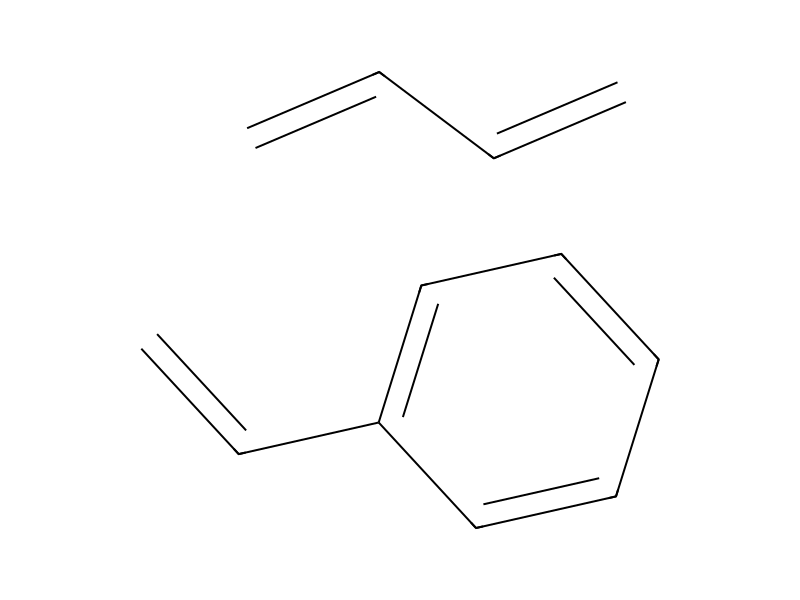
O1[CH2:5][CH2:4][CH2:3][CH2:2]1.[CH2:6]([Li])[CH2:7][CH2:8][CH3:9]>CCCCCC>[CH2:2]=[CH:3][CH:4]=[CH2:5].[CH2:2]=[CH:3][C:4]1[CH:5]=[CH:9][CH:8]=[CH:7][CH:6]=1.[CH2:2]=[CH:3][CH:4]=[CH2:5].[CH2:2]=[CH:3][C:4]1[CH:5]=[CH:9][CH:8]=[CH:7][CH:6]=1Participants
Reactant 2


Product 3


Reagents, catalysts & solvents 1

Procedure
500 ml of butadiene and 270 ml of styrene are polymerized in 2,700 ml of mineral oil (viscosity 2.3° E/50° C) in the presence of 6.0 ml of tetrahydrofuran at 50° C, by means of 10 ml of a 5% strength solution of n-butyl-lithium in hexane. The polymerization time is 3.5 hours. A random butadiene-styrene copolymer is formed, which according to the IR spectrum contains 40% of styrene and has a 1,2-vinyl content of the butadiene units of 27%, based on copolymerized butadiene. The number-average molecular weight, determined in toluene at 37° C by means of a membrane osmometer, is about 75,000. 20 ml of a homogeneous catalyst solution, comprising 0.3 g of nickel-II acetylacetonate, 10 ml of a 20% strength aluminum-triisobutyl solution in hexane and 10 ml of toluene, are then added to the polymer solution. Hydrogenation is carried out under a pressure of 10 bars of hydrogen at 75° C. After the hydrogenation, the proportion of olefinic double bonds in the random butadiene-styrene copolymer was found to have been reduced to a residual proportion of about 0.5% (determined from the IR spectrum). The ratio of the extinction of the styrene bands in the IR spectrum (recorded by means of an IR-spectrophotometer from Perkin-Elmer, Model 521), i.e., E(1,180)/E(1,150) and E(1,190)/E(1,180), of the selectively hydrogenated random butadiene-styrene copolymer is respectively 0.72 and 0.18. In the 13C-NMR spectrum, the ratio ΣCH2 (β and ethyl)/ΣCH2 (γ, δ and more remote) is 1:1.15.
Sources & evidence
- ORD record
- ord-a91720c191544e9ab8ac624aa25ea957
- Source dataset
- uspto-grants-1978_02
- Patent number
- US04073738
Reaction notes
Loading…