Hydrochloric Acid → 2,3-Dihydro-4-iodo-5-phenylbenzofuran
Reaction equation

[C:1]1([C:7]2[C:15](N)=[C:11]3[CH2:12][CH2:13][O:14][C:10]3=[CH:9][CH:8]=2)[CH:6]=[CH:5][CH:4]=[CH:3][CH:2]=1.Cl.N([O-])=O.[Na+].[I-:22].[K+]>O.[Cl-].[Na+].O.CCOCC>[I:22][C:15]1[C:11]2[CH2:12][CH2:13][O:14][C:10]=2[CH:9]=[CH:8][C:7]=1[C:1]1[CH:6]=[CH:5][CH:4]=[CH:3][CH:2]=1Participants
Reactant 4


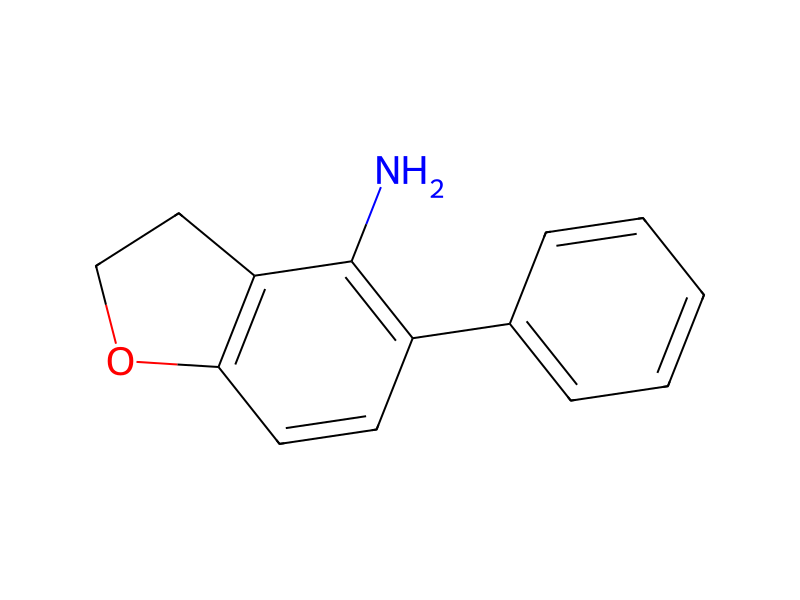

Product 1

Reagents, catalysts & solvents 3



Procedure
A mechanically stirred solution of 2,3-dihydro-5-phenyl-4-benzofuranamine (1.88 g, 8.90 mmol), ice (~5 g), and concentrated hydrochloric acid (3.9 mL) at 5° C. was treated slowly with a solution of sodium nitrite (0.675 g, 9.78 mmol) in H2O (4 mL). The resulting suspension was stirred 15 min and filtered through a plug of glass wool into a solution of potassium iodide (5.00 g, 30.1 mmol) in H2O. The suspension was allowed to stand for 12 h, treated with Et2O (200 mL) and brine (200 mL), the layers separated, and the aqueous layer further extracted with fresh Et2O (2×300 mL). The combined organic portions were, filtered, washed with 1 N HCl (2×300 mL), brine (200 mL), dried (K2CO3), filtered, and concentrated in vacuo to afford 1.63 g (57%) of the product as a clear oil: 1H NMR (300 MHz, CDCl3) δ 3.23 (t, J=8 Hz, 2H), 4.63 (t, J=8 Hz, 2H), 6.75 (d, J=8 Hz, 1H), 7.02 (d, J=8 Hz, 1H), 7.29-7.42 (m, 5H).
Workup
- waitto stand for 12 h
- customthe layers separated
- extractionthe aqueous layer further extracted with fresh Et2O (2×300 mL)
- filtrationfiltered
- washwashed with 1 N HCl (2×300 mL), brine (200 mL)
- dry with materialdried (K2CO3)
- filtrationfiltered
- concentrationconcentrated in vacuo
Sources & evidence
- ORD record
- ord-0762687139e442a1a0b5dfefb19dd8c3
- Source dataset
- uspto-grants-1999_09
- Patent number
- US05948817
Reaction notes
Loading…