Dichloromethane → HCID 21846056, compound
Reaction equation

[C:1]([C:3]1[CH:4]=[C:5]2[C:10](=[CH:11][CH:12]=1)[N:9]([CH3:13])[C:8](=[O:14])[CH:7]=[C:6]2[CH2:15][CH2:16]O)#[N:2].[Br:18]P(Br)(C1C=CC=CC=1)(C1C=CC=CC=1)C1C=CC=CC=1.ClCCl>C(OCC)C>[Br:18][CH2:16][CH2:15][C:6]1[C:5]2[C:10](=[CH:11][CH:12]=[C:3]([C:1]#[N:2])[CH:4]=2)[N:9]([CH3:13])[C:8](=[O:14])[CH:7]=1Participants
5
Reactant 3

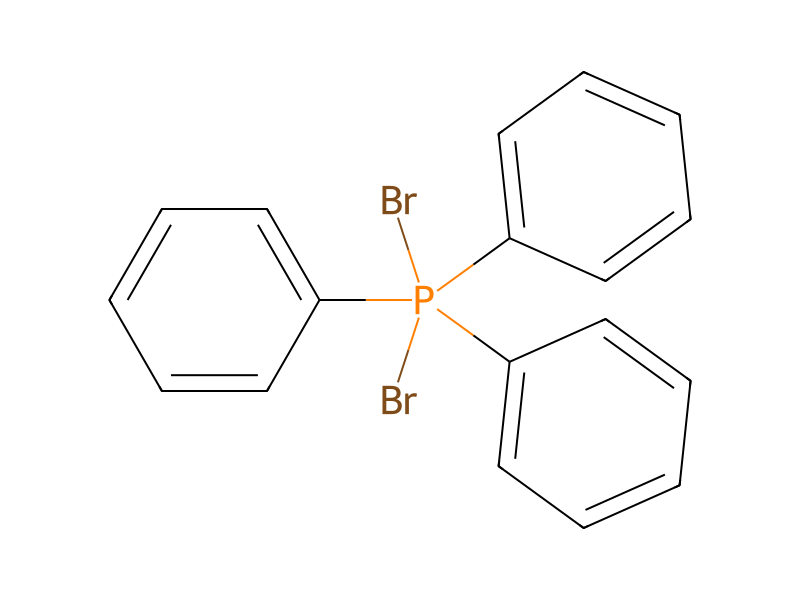

Product 1

Reagents, catalysts & solvents 1

Procedure
0.24 g (1.05 mmol) of 6- cyano-4-(2-hydroxyethyl)-1-methyl-2(1H)-quinolone is added in small amounts to 0.48 g (1.14 mmol) of dibromotriphenylphosphorane in 14 ml of dichdoromethane at room temperature. After 75 minutes of stirring at room temperature, the reaction medium is poured into 200 ml of dichloromethane and the mixture is washed with water. The organic phase is dried over sodium sulphate, filtered and condensed under vacuum. The white residue is ground in diethylether. The solid obtained is taken up in a minimum of dichloromethane, the mixture is filtered rapidly through a layer of silica, eluting with ether, and the filtrate is evaporated.
Workup
- washthe mixture is washed with water
- dry with materialThe organic phase is dried over sodium sulphate
- filtrationfiltered
- customcondensed under vacuum
- customThe solid obtained
- filtrationthe mixture is filtered rapidly through a layer of silica
- washeluting with ether
- customthe filtrate is evaporated
Sources & evidence
- ORD record
- ord-676df577da584d96b58a1146095ef8b2
- Source dataset
- uspto-grants-1999_09
- Patent number
- US05958924
Reaction notes
Loading…