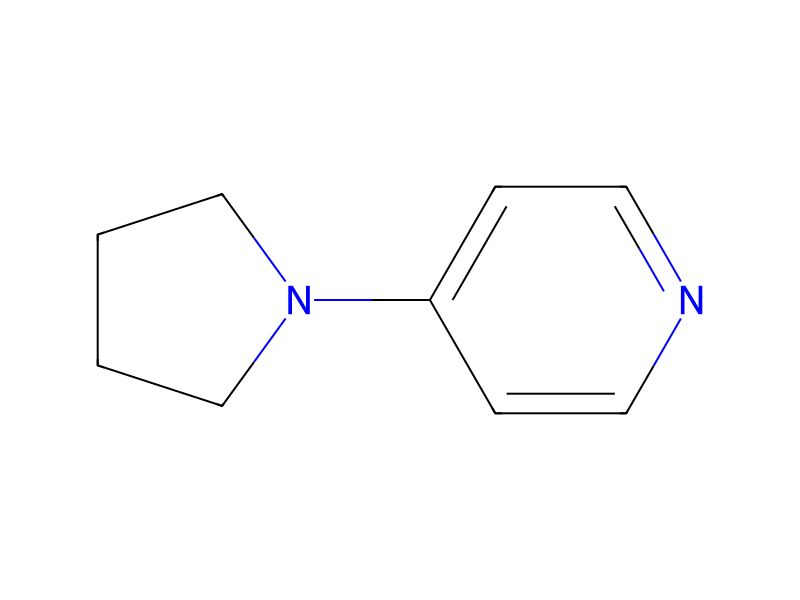
Sodium Hydroxide → 4-Pyrrolidinopyridine
Reaction equation

[Cl-].C(CC[N+:7]1[CH:12]=[CH:11][C:10](C#N)=[CH:9][CH:8]=1)(=O)N.[NH:15]1[CH2:19][CH2:18][CH2:17][CH2:16]1.[OH-].[Na+].[OH-].[Na+]>O>[N:15]1([C:10]2[CH:9]=[CH:8][N:7]=[CH:12][CH:11]=2)[CH2:19][CH2:18][CH2:17][CH2:16]1Participants
5
Reactant 3



Product 1
Reagents, catalysts & solvents 1

Procedure
A solution of 1-(2-carbamoylethyl)-4-cyanopyridinium chloride (21.2 g; 0.1 mole) dissolved in 15 ml of deionized water was prepared and charged to the dropping funnel. This solution was then added to the pyrrolidine/sodium hydroxide solution at a rate which permitted maintenance of the reaction temperature with stirring at below 5° C. It was held there for an additional hour, after which 14 g (0.175 mole) of a 50% (w/w) sodium hydroxide solution was added dropwise with continued maintenance of the reaction temperature below 5° C. (approximately 45 minutes). The mixture was then heated to reflux and maintained for two hours and then allowed to cool.
Workup
- customwas prepared
- additioncharged to the dropping funnel
- waitIt was held there for an additional hour
- temperatureThe mixture was then heated
- temperatureto reflux
- temperaturemaintained for two hours
- temperatureto cool
Sources & evidence
- ORD record
- ord-0a8c4191d8a54cdcb4bb61c458dedfe6
- Source dataset
- uspto-grants-1988_09
- Patent number
- US04772713
Reaction notes
Loading…