1,4-Dioxane → 1-(sec-butyl)-N-((4,6-dimethyl-2-oxo-1,2-dihydropyridin-3-yl)methyl)-3-methyl-6-(6-(piperazin-1-yl)pyridin-3-yl)-1H-indole-4-carboxamide
Reaction equation

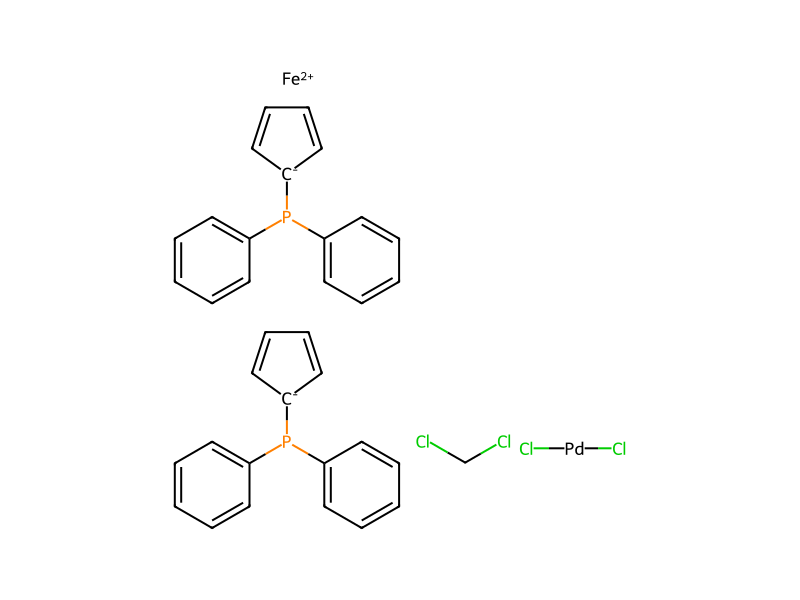
Br[C:2]1[CH:3]=[C:4]([C:16]([NH:18][CH2:19][C:20]2[C:21](=[O:28])[NH:22][C:23]([CH3:27])=[CH:24][C:25]=2[CH3:26])=[O:17])[C:5]2[C:6]([CH3:15])=[CH:7][N:8]([CH:11]([CH2:13][CH3:14])[CH3:12])[C:9]=2[CH:10]=1.CC1(C)C(C)(C)OB([C:37]2[CH:38]=[CH:39][C:40]([N:43]3[CH2:48][CH2:47][NH:46][CH2:45][CH2:44]3)=[N:41][CH:42]=2)O1.P([O-])([O-])([O-])=O.[K+].[K+].[K+].O1CCOCC1>C1C=CC(P(C2C=CC=CC=2)[C-]2C=CC=C2)=CC=1.C1C=CC(P(C2C=CC=CC=2)[C-]2C=CC=C2)=CC=1.Cl[Pd]Cl.[Fe+2].C(Cl)Cl.CCOC(C)=O.O>[CH:11]([N:8]1[C:9]2[CH:10]=[C:2]([C:37]3[CH:42]=[N:41][C:40]([N:43]4[CH2:44][CH2:45][NH:46][CH2:47][CH2:48]4)=[CH:39][CH:38]=3)[CH:3]=[C:4]([C:16]([NH:18][CH2:19][C:20]3[C:21](=[O:28])[NH:22][C:23]([CH3:27])=[CH:24][C:25]=3[CH3:26])=[O:17])[C:5]=2[C:6]([CH3:15])=[CH:7]1)([CH2:13][CH3:14])[CH3:12]Participants
Reactant 4




Product 1

Reagents, catalysts & solvents 3


Procedure
Added sequentially to a reaction vial were 6-bromo-1-(sec-butyl)-N-((4,6-dimethyl-2-oxo-1,2-dihydropyridin-3-yl)methyl)-3-methyl-1H-indole-4-carboxamide (0.15 g, 0.338 mmol), 1-(5-(4,4,5,5-tetramethyl-1,3,2-dioxaborolan-2-yl)pyridin-2-yl)piperazine (0.127 g, 0.439 mmol), and potassium phosphate (tribasic) (0.287 g, 1.350 mmol), followed by 1,4-Dioxane (3 mL) and water (0.75 mL). The suspension was stirred under N2 degassing for 10 min., and then added PdCl2(dppf)-CH2Cl2 adduct (0.028 g, 0.034 mmol). The reaction vial was sealed, placed into a heat block at 95° C., and stirred for 1.5 h. The contents were removed from heating and allowed to cool to room temperature. The aq layer was removed from bottom of the reaction vial via pipette. The reaction mixture was diluted into EtOAc (20 mL) followed by addition of 0.2 g each of Thiol-3 silicycle resin and silica gel. The volatiles were removed in vacuo and the residue dried on hi-vac for 1 h. The contents were purified by silica gel chromatography (dry loaded, eluent: A: Dichloromethane, B: 10% (2M Ammonia in Methanol) in Chloroform, Gradient B: 8-95%). The obtained solid was concentrated from TBME and dried in vacuum oven at 45° C. for 18 h. The product was collected as 129 mg (70%). 1H NMR (400 MHz, DMSO-d6) δ ppm 0.73 (t, J=7.33 Hz, 3H), 1.40 (d, J=6.57 Hz, 3H), 1.80 (dq, J=10.07, 7.08 Hz, 2H), 2.11 (s, 3H), 2.14-2.19 (m, 3H), 2.24 (s, 3H), 2.76-2.85 (m, 4H), 3.41-3.49 (m, 4H), 4.35 (d, J=5.05 Hz, 2H), 4.54-4.67 (m, 1H), 5.87 (s, 1H), 6.88 (d, J=8.84 Hz, 1H), 7.17 (d, J=1.26 Hz, 1H), 7.26 (s, 1H), 7.73 (d, J=1.26 Hz, 1H), 7.91 (dd, J=8.84, 2.53 Hz, 1H), 8.16 (t, J=5.05 Hz, 1H), 8.50 (d, J=2.53 Hz, 1H), 11.48 (br. s., 1H); LCMS MH+=527.3.
Workup
- additionAdded sequentially to a reaction
- customThe reaction
- customvial was sealed
- customplaced into a heat block at 95° C.
- stirringstirred for 1.5 h
- customThe contents were removed
- temperaturefrom heating
- customThe aq layer was removed from
- custombottom of the reaction vial via pipette
- customThe volatiles were removed in vacuo
- customthe residue dried on hi-vac for 1 h
- customThe contents were purified by silica gel chromatography (
- customdry
- concentrationThe obtained solid was concentrated from TBME
- customdried in vacuum oven at 45° C. for 18 h
- customThe product was collected as 129 mg (70%)
Sources & evidence
- ORD record
- ord-6e085e733c5a4288b6012662e4489ee8
- Source dataset
- uspto-grants-2016_09
- Patent number
- US09446041B2
Reaction notes
Loading…