HuagongsheHuagongshe Chemistry Print Report · For research reference only
HRID 626088Generated: October 26, 2026
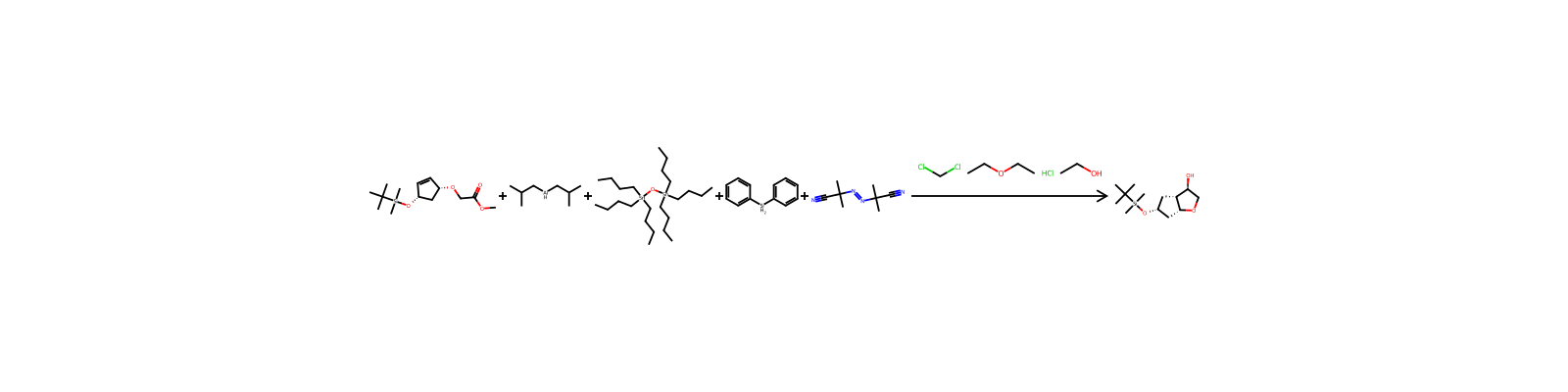
Azobisisobutyronitrile → (3R,3aR,5R,6aR)-5-((tert-butyldimethylsilyl)oxy)hexahydro-2H-cyclopenta[b]furan-3-ol
https://huagongshe.com/reaction/626088
Participants
| Role | Name | HCID | Charge |
|---|
| Reactant | Azobisisobutyronitrile | HCID 6547 | — |
| Reactant | Diisobutylaluminum hydride | HCID 14487 | — |
| Reactant | Diphenylsilane | HCID 69888 | — |
| Reactant | Bis(tributyltin) oxide | HCID 16682746 | — |
| Reactant | Methyl 2-(((1R,4S)-4-((tert-butyldimethylsilyl)oxy)cyclopent-2-en-1-yl)oxy)acetate | HCID 53465922 | — |
| Solvent | Hydrochloric Acid | HCID 313 | — |
| Solvent | Ethanol | HCID 702 | — |
| Solvent | Diethyl Ether | HCID 3283 | — |
| Solvent | Dichloromethane | HCID 6344 | — |
| Product | (3R,3aR,5R,6aR)-5-((tert-butyldimethylsilyl)oxy)hexahydro-2H-cyclopenta[b]furan-3-ol | HCID 53465923 | 64% |
Reaction Steps
A solution of methyl ester 10 (87.2 mg, 0.304 mmol) in dry CH2Cl2 (8 mL) was cooled to −78° C. under argon. DIBAL-H (1M sol. in hexanes, 0.40 mL) was added slowly and the reaction mixture was stirred for 1 h at this temperature. The reaction was quenched by addition of MeOH (100 μL) and the mixture was warmed to rt. A pH 7 phosphate buffer (0.5M solution, 2 mL) was added. The aqueous phase was extracted with CH2Cl2 (3×) and the combined organic phase washed with brine, dried (Na2SO4), filtered, and evaporated in vacuo. The crude aldehyde solution was passed through a short plug of silica gel, initially deactivated with 1% Et3N, using hexanes/EtOAc (5:1) as the eluent. After evaporation, the crude product was directly submitted to the next step. The residue was re-dissolved in dry benzene (degassed, 2 mL) under argon and the solution transferred into a sealable tube. (nBu3Sn)2O (22.5 μL, 26.3 mg, 44 μmol), Ph2SiH2 (42 μL, 41.6 mg, 0.22 mmol), EtOH (45 μL), and AIBN (10 mg) were successively added. The sealed tube was placed with stirring in an oil bath at 80° C. for 6 h. After cooling to room temperature, the reaction mixture was diluted with Et2O (2 mL) and aqueous 0.5M HCl solution (2 mL) was added. After stirring at room temperature for 15 min, the aqueous phase was extracted with Et2O (3×). The combined organic phase was washed with saturated aqueous NaHCO3 solution, brine, dried (MgSO4), filtered, and evaporated. The residue was purified by flash chromatography on silica gel using hexanes/EtOAc (6:1 to 2:1) to afford the (R)-alcohol 11 (50 mg, 64% over 2 steps) as a white solid; 5 mg of the other 3-(S)-diastereoisomer was also isolated and only traces of 1,2 reduction product were observed. TLC: Rf=0.46 (hexanes/EtOAc=3:1); [α]D20+22.3° (c 0.67, CHCl3); 1H NMR (CDCl3, 300 MHz) δ 4.69 (dt, J=3.8, 7.2 Hz, 1H), 4.19-4.02 (m, 3H), 3.72 (d, J=9.8 Hz, 1H), 2.48 (q, J=7.5 Hz, 1H), 2.13-1.96 (m, 2H), 1.70-1.55 (m, 2H), 1.47-1.25 (m, 1H), 0.86 (s, 9H), 0.03 (s, 6H); 13C NMR (CDCl3, 75 MHz) δ 82.2, 78.3, 73.1, 72.7, 50.9, 42.4, 39.0, 25.8, 17.5, −4.8, −4.9.
Provenance & Evidence
| DOI | 10.6084/m9.figshare.5104873.v1 |
|---|
| Patent number | US09309213B2 |
|---|
| Source dataset | uspto-grants-2016_04 |
|---|
| ORD ID | ord-925ba771e479405781c9698a3ca5a040 |
|---|
| Source note | uspto-grants-2016_04 |
|---|