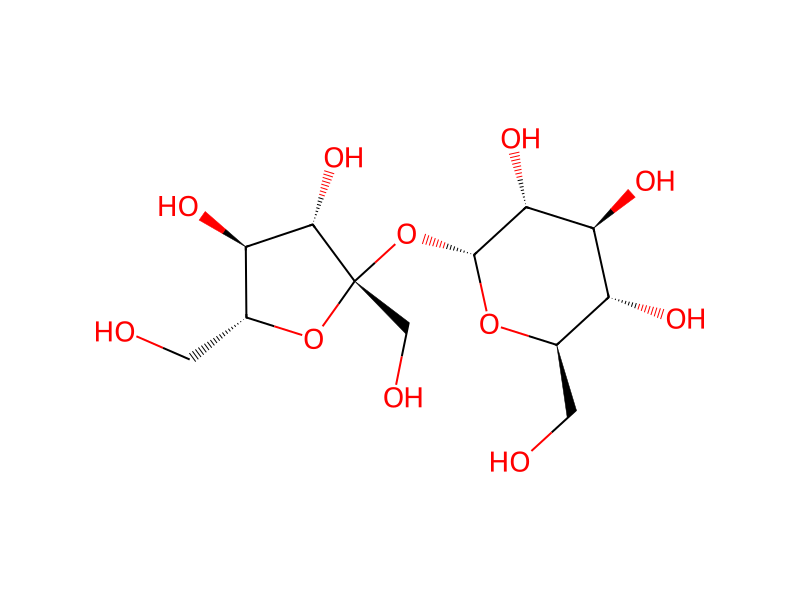
Sucrose → 6'-Chloro-6'-deoxysucrose
Reaction equation

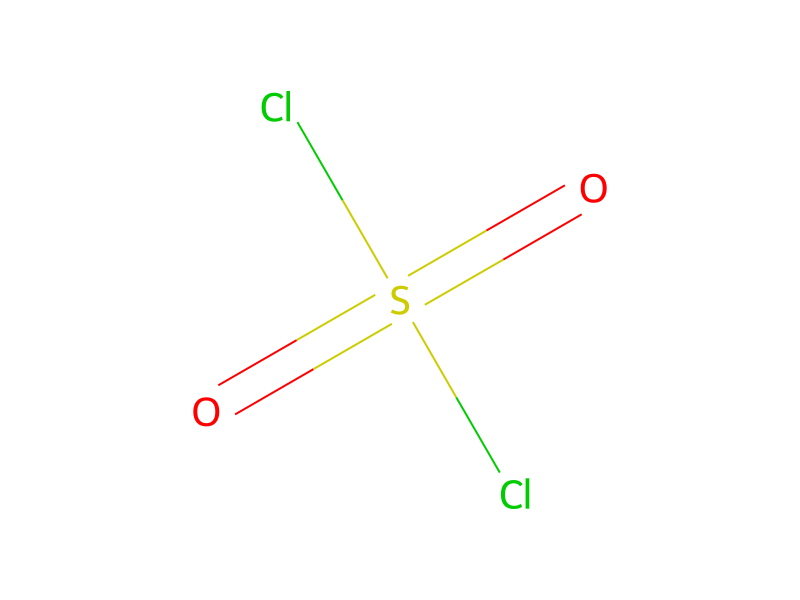
S(Cl)([Cl:4])(=O)=O.[CH2:6]([OH:28])[C@H:7]1[O:12][C@H:11]([O:13][C@:14]2([CH2:23][OH:24])[O:18][C@H:17]([CH2:19]O)[C@@H:16]([OH:21])[C@@H:15]2[OH:22])[C@H:10]([OH:25])[C@@H:9]([OH:26])[C@@H:8]1[OH:27]>N1C=CC=CC=1>[CH2:6]([OH:28])[C@H:7]1[O:12][C@H:11]([O:13][C@@:14]2([CH2:23][OH:24])[O:18][C@H:17]([CH2:19][Cl:4])[C@@H:16]([OH:21])[C@@H:15]2[OH:22])[C@H:10]([OH:25])[C@@H:9]([OH:26])[C@@H:8]1[OH:27]Participants
Reactant 2
Product 1

Reagents, catalysts & solvents 1

Procedure
Attempts to synthesize cyclic sulfates of unprotected sugars with sulfuryl chloride and pyridine have been reported. However, the reaction has never been clean and several side products were isolated. For example, reaction of sucrose with sulfuryl chloride at −78° C. affords the 6,6′-dichloro-6,6′-deoxysucrose and 6′-chloro-6′-deoxysucrose in 43% and 29% yield. At room temperature, a complex mixture is formed from which 3′,4′-anhydro-1′,6′-dichloro-1′,6′-dideoxy-β-D-ribo-hexulo-furanoside 2,3-cyclic sulfate is isolated in 17% yield, showing that chlorination occurs as well as inversion of configuration during cyclic sulfate formation. Thus, the reaction of sulfuryl chloride with carbohydrates containing free hydroxyl groups has become a well established method for the preparation of chlorodeoxysugars. The conversion of a vicinal cis diol system to a cyclic sulfate in protected carbohydrates is readily accomplished with sulfuryl chloride. By using SO2Cl2, the methyl 4,6-O-benzilidene-β-D-mannopyranoside 2,3-cyclic sulfate, and 1,6-anhydro-4-O-benzyl-β-D-mannopyranoside 2,3-cyclic sulfate [28] were obtained in 60% and 85% yield.
Workup
- customseveral side products were isolated
- customat −78° C.
Sources & evidence
- ORD record
- ord-bec7639e4b9e481ebc8fa730a20cf47f
- Source dataset
- uspto-grants-2001_02
- Patent number
- US06184196B2
Reaction notes
Loading…