Sodium Hydroxide → 2-Bromo-3-(3-pyridyl)-5,6,7,8-tetrahydroindolizine-1-carboxylic acid
Reaction equation

[OH-].[Na+].[Br:3][C:4]1[C:5]([C:19]([O:21]C)=[O:20])=[C:6]2[N:11]([C:12]=1[C:13]1[CH:14]=[N:15][CH:16]=[CH:17][CH:18]=1)[CH2:10][CH2:9][CH2:8][CH2:7]2>CO>[Br:3][C:4]1[C:5]([C:19]([OH:21])=[O:20])=[C:6]2[N:11]([C:12]=1[C:13]1[CH:14]=[N:15][CH:16]=[CH:17][CH:18]=1)[CH2:10][CH2:9][CH2:8][CH2:7]2Participants
4
Reactant 2


Product 1
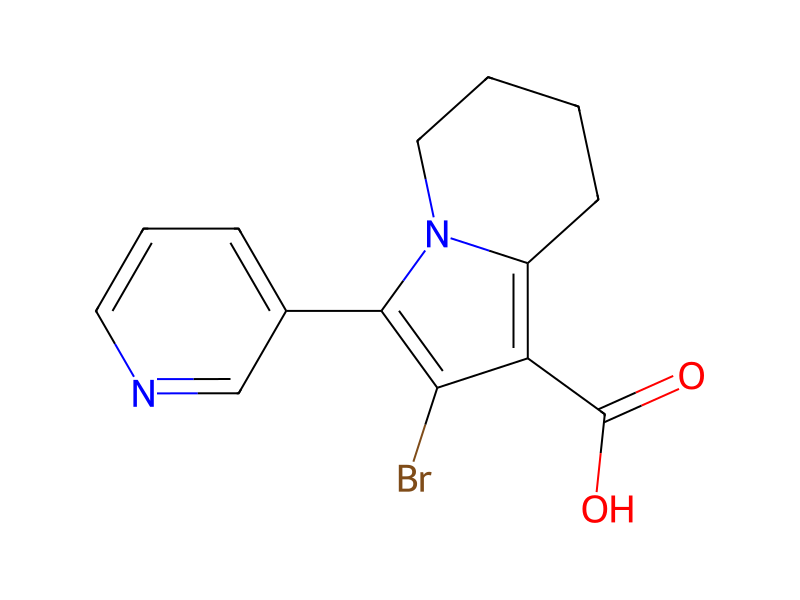
Reagents, catalysts & solvents 1

Procedure
1 cm3 of 5N sodium hydroxide is added with stirring to a solution of 0.34 g of methyl 2-bromo-3-(3-pyridyl)-5,6,7,8-tetrahydroindolizine-1-carboxylate in methanol at 20° C. The orangy solution is heated to reflux for 15 hours. The solvent is then evaporated off at reduced pressure (2.7 kPa) at a temperature close to 40° C. The residue is taken up with 10 cm3 of water and acidified to pH˜3 with 0.2 cm3 of 12N hydrochloric acid and 0.5 cm3 of 1N acetic acid. The precipitate is filtered off, washed with water and then dried in air. 0.29 g of 2-bromo-3-(3-pyridyl)-5,6,7,8-tetrahydroindolizine-1-carboxylic acid are thus obtained in the form of a cream powder which melts at >260° C., with decomposition.
Workup
- temperatureThe orangy solution is heated
- temperatureto reflux for 15 hours
- customThe solvent is then evaporated off at reduced pressure (2.7 kPa) at a temperature
- customclose to 40° C
- filtrationThe precipitate is filtered off
- washwashed with water
- customdried in air
Sources & evidence
- ORD record
- ord-5c48c4ff97d84301986994b8ab715e1a
- Source dataset
- uspto-grants-2001_02
- Patent number
- US06194426B1
Reaction notes
Loading…