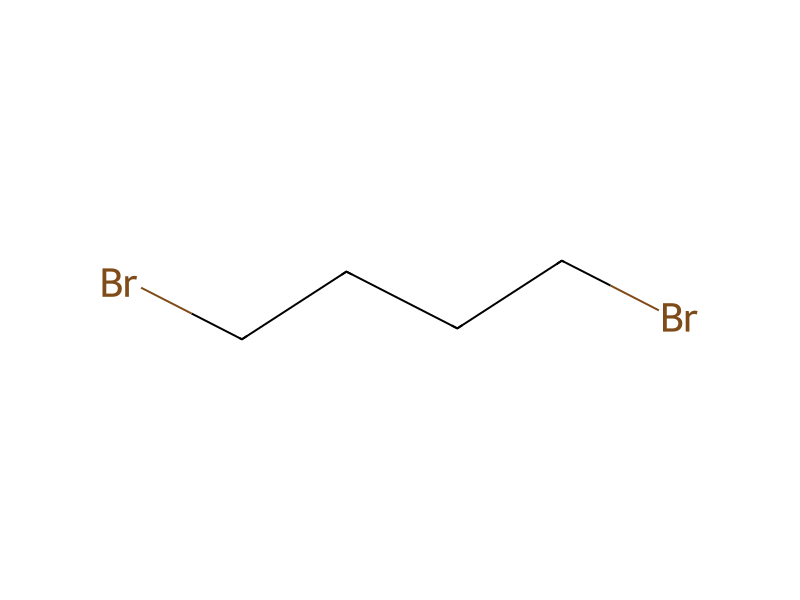
1,4-Dibromobutane → 5-Chloro-3-methyl-6-(pyrrolidin-1-yl)-benzofuran
Reaction equation

[NH2:1][C:2]1[C:11]([Cl:12])=[CH:10][C:5]2[C:6]([CH3:9])=[CH:7][O:8][C:4]=2[CH:3]=1.Br[CH2:14][CH2:15][CH2:16][CH2:17]Br.C(N(C(C)C)C(C)C)C>C(O)C>[Cl:12][C:11]1[C:2]([N:1]2[CH2:17][CH2:16][CH2:15][CH2:14]2)=[CH:3][C:4]2[O:8][CH:7]=[C:6]([CH3:9])[C:5]=2[CH:10]=1Participants
5
Reactant 3


Product 1

Reagents, catalysts & solvents 1

Procedure
A mixture of 9.1 g (50 mmole) of 6-amino-5-chloro-3-methylbenzofuran, 11.8 ml (0.1 mole) of 1,4-dibromobutane, 17.1 ml (0.1 mole) of N-ethyldiisopropylamine and 60 ml of ethanol is boiled under reflux for 24 hours and then concentrated by evaporation in vacuo. The residue is partitioned between methylene chloride and saturated sodium bicarbonate solution. The crude product obtained after drying and concentration by evaporation of the methylene chloride is chromatographed with petroleum ether/ether over silica gel. Subsequent distillation in a bulb tube (150°/10-1 torr) yields 5-chloro-3-methyl-6-(pyrrolidin-1-yl)-benzofuran having a melting point of 50°-52°.
Workup
- temperatureunder reflux for 24 hours
- concentrationconcentrated by evaporation in vacuo
- customThe residue is partitioned between methylene chloride and saturated sodium bicarbonate solution
- customThe crude product obtained
- customafter drying
- concentrationconcentration
- customby evaporation of the methylene chloride
- customis chromatographed with petroleum ether/ether over silica gel
- distillationSubsequent distillation in a bulb tube (150°/10-1 torr)
Sources & evidence
- ORD record
- ord-220f058344494205a4cde4decc2594ca
- Source dataset
- uspto-grants-1985_12
- Patent number
- US04558043
Reaction notes
Loading…