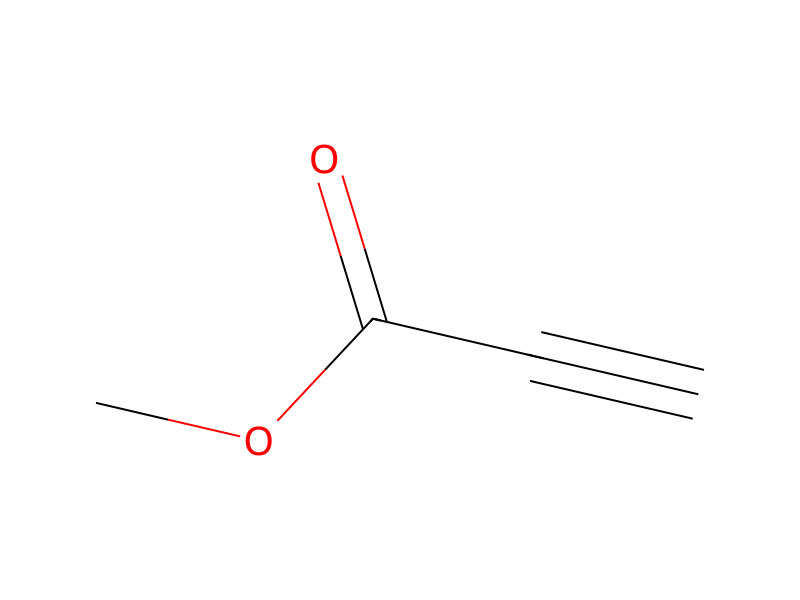
Methyl propiolate → 5-Butanoyl-6-methylpyridin-2(1H)-one
Reaction equation

[NH2:1][C:2](=[CH:4][C:5](=[O:9])[CH2:6][CH2:7][CH3:8])[CH3:3].[C:10](OC)(=[O:13])[C:11]#[CH:12]>CN(C)C=O>[C:5]([C:4]1[CH:12]=[CH:11][C:10](=[O:13])[NH:1][C:2]=1[CH3:3])(=[O:9])[CH2:6][CH2:7][CH3:8]Participants
Reactant 2

Product 1

Reagents, catalysts & solvents 1

Procedure
A mixture containing 22.2 g of 3-methyl-5-n-propylisoxazole [Kashima et al., Bull. Chem. Soc. Japan 46, 310-313 (1973)], 500 mg of platinum dioxide and 200 ml of ethanol was hydrogenated under catalytic hydrogenation conditions for ninety minutes, the catalyst was filtered off and the filtrate was concentrated on a rotary evaporator to yield 18.5 g of colorless residue which solidified on cooling. The residue containing 2-amino -2-hepten-4-one was dissolved in 50 ml of dimethylformamide and to the solution was added 14.8 g of methyl 2-propynoate. The resulting reaction solution was allowed to stand at ambient temperature for thirty minutes (exothermic) and then refluxed for three and one half hours. The dimethylformamide was removed on a rotary evaporator. The remaining dark brown liquid was heated in an oil bath at 195°-200° C. for four hours, cooled to room temperature, crystallized from isopropyl alcohol and dried at 80°-85° C. to produce, as pale yellow flakes, 9.4 g of 5-(n-butanoyl)-6-methyl-2(1H)-pyridinone, m.p. 167°-168° C.
Workup
- temperatureon cooling
- customThe resulting reaction solution
- waitto stand at ambient temperature for thirty minutes
- temperature(exothermic) and then refluxed for three and one half hours
- customThe dimethylformamide was removed on a rotary evaporator
- temperatureThe remaining dark brown liquid was heated in an oil bath at 195°-200° C. for four hours
- customcrystallized from isopropyl alcohol
- customdried at 80°-85° C.
Sources & evidence
- ORD record
- ord-f1c94ed373dd4f559172fb79b6aca8f5
- Source dataset
- uspto-grants-1985_12
- Patent number
- US04559347
Reaction notes
Loading…