Glyoxal → 6-Bromoquinoxaline
Reaction equation

[Br:1][C:2]1[CH:3]=[C:4]([NH2:9])[C:5]([NH2:8])=[CH:6][CH:7]=1.[CH:10]([CH:12]=O)=O>CO>[Br:1][C:2]1[CH:3]=[C:4]2[C:5](=[CH:6][CH:7]=1)[N:8]=[CH:12][CH:10]=[N:9]2Participants
Reactant 2
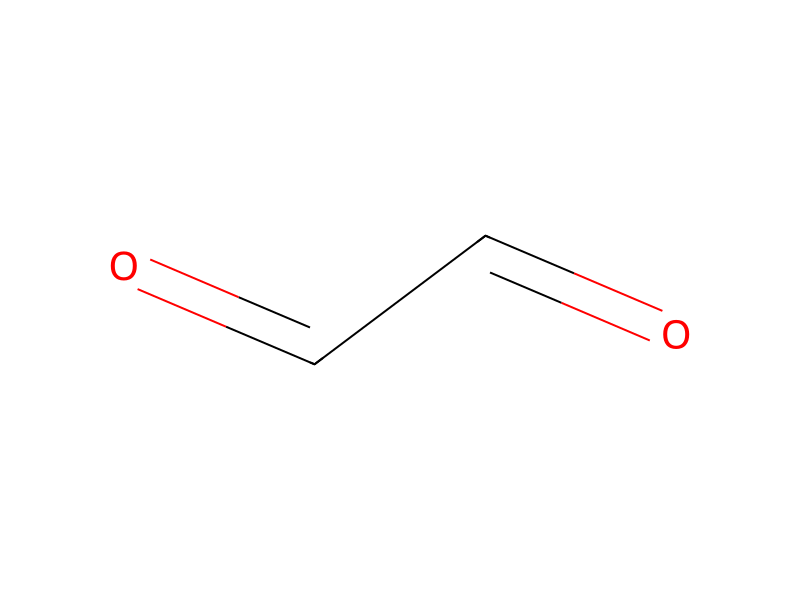
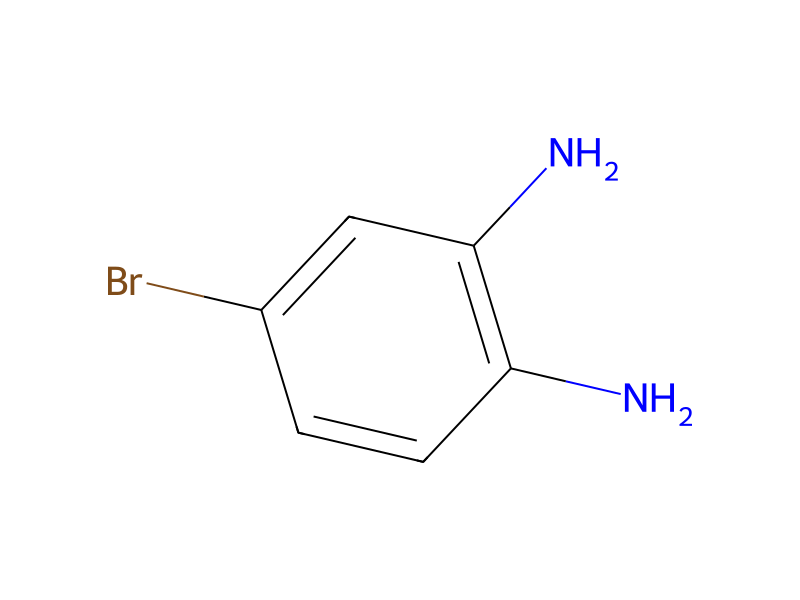
Product 1

Reagents, catalysts & solvents 1

Procedure
In a round bottom flask under nitrogen was combined 4-Bromo-benzene-1,2-diamine (2.01 g, 10.7 mMol), methanol (50 mL), and glyoxal (40% by wt. 3.1 mL, 26.9 mMol) and the resulting solution stirred overnight. Upon arrival the reaction was concentrated to dryness on a rotary evaporator and purified by flash column chromatography on silica gel using 5-10% ethyl acetate in dichloromethane as eluant to yield 1.14 g (50% yield) of 6-Bromo-quinoxaline as a yellow-orange solid. 1H NMR (DMSO-d6): δ=9.00 (d, 2H, J=2.8 Hz), 8.36 (d, 1H, J=2.2 Hz), 8.07 (d, 1H, J=9.0 Hz), 8.02 (dd, 1H, J=8.8, 2.1 Hz). CHN for C8H5BrN2: calc. C, 45.97; H, 2.41; N, 13.4. found C, 45.99; H 2.09; N 13.09. LC/MS (Method A), rt=1.10 mins., purity=99%, calculated mass=208, [M+H]+=209/21. HPLC (Method C): rt=7.4 mins., purity=98.52% @ 210-370 nm and 98.8% @ 322 nm.
Workup
- customIn a round bottom flask under nitrogen was combined
- concentrationUpon arrival the reaction was concentrated to dryness on a rotary evaporator
- custompurified by flash column chromatography on silica gel using 5-10% ethyl acetate in dichloromethane as eluant
Sources & evidence
- ORD record
- ord-68a383bb9e654440a87f80dce351e413
- Source dataset
- uspto-grants-2010_04
- Patent number
- US07696210B2
Reaction notes
Loading…