(4-Nitrophenyl)acetic acid → 6-Nitro-3-p-nitrophenylchromen-2-one
Reaction equation

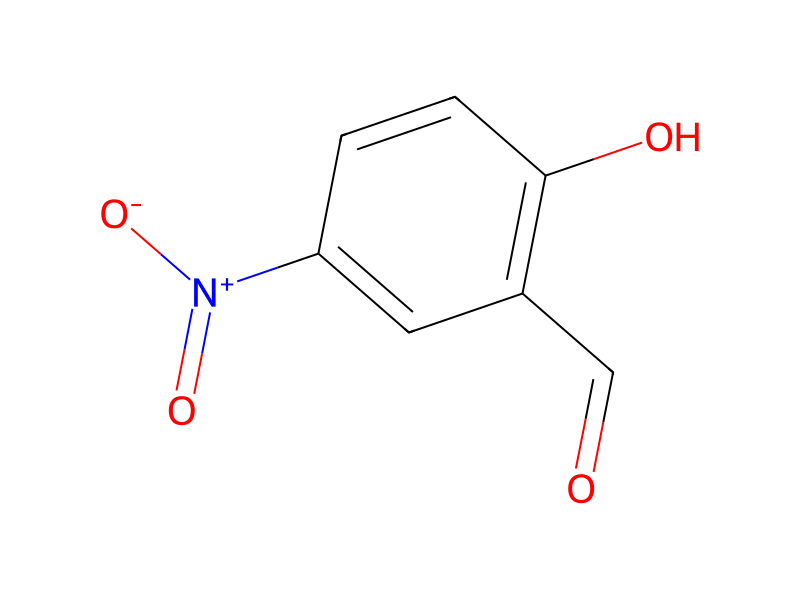
[OH:1][C:2]1[CH:9]=[CH:8][C:7]([N+:10]([O-:12])=[O:11])=[CH:6][C:3]=1[CH:4]=O.[N+:13]([C:16]1[CH:21]=[CH:20][C:19]([CH2:22][C:23](O)=[O:24])=[CH:18][CH:17]=1)([O-:15])=[O:14].C(OC(=O)C)(=O)C.[H-].[Na+]>C(O)(=O)C.O>[N+:10]([C:7]1[CH:6]=[C:3]2[C:2](=[CH:9][CH:8]=1)[O:1][C:23](=[O:24])[C:22]([C:19]1[CH:18]=[CH:17][C:16]([N+:13]([O-:15])=[O:14])=[CH:21][CH:20]=1)=[CH:4]2)([O-:12])=[O:11]Participants






Conditions
- Temperature
- 100 °C
Procedure
2-Hydroxy-5-nitrobenzaldehyde (250 mg, 1.50 mmol) and p-nitrophenylacetic acid (271 mg, 1.50 mmol) were placed in a dry 25-mL round bottom flask. Acetic anhydride (2.8 mL, 30 mmol) was then added with stirring. To this suspension sodium hydride (60 mg, 1.50 mmol) was then added in small aliquots (60% oil suspension) and the reaction mixture was heated to 100° C. for 3 h. Then, 100 μL of water and 3 mL of acetic acid were added. The mixture was cooled to 4° C. for one hour and then filtered. The solid was rinsed with cold glacial acetic acid and placed in a 100-mL flask, to which was added 30 mL of toluene, which was then removed by rotary evaporation. This addition and removal of toluene was repeated two more times to remove the last traces of acetic acid. The resulting solid was then dried under vacuum to give a beige powder (11) in 70% yield (325 mg, 1.05 mmol). mp: 250° C. (dec). FTIR (KBr) (cm−1): 1620, 1480, 1750, 1540, 1350. 1H-NMR (DMSO-d6): δ (ppm) 8.80 (d, J=2.6 Hz, 1H), 8.62 (s, 1H), 8.47 (dd, J=9.1 Hz, J=2.7 Hz, 1H), 8.37 (dd, J=8.9 Hz, J=2.0 Hz, 1H), 8.02 (dd, J=8.9 Hz, J=2.0 Hz, 2H), 7.71 (d, J=9.1 Hz, 1H). 13C-NMR (DMSO-d6): δ (ppm) 159.43, 157.87, 148.46, 144.68, 142.30, 141.50, 130.85, 127.92, 125.77, 124.51, 120.53, 118.64. HRMS: expected, 312.038236; found, 312.039100. Elemental analysis for C15H8N2O6: expected: C, 57.70; H, 2.58; N, 8.97; found: C, 57.37; H, 2.62; N, 8.78.
Workup
- temperatureThe mixture was cooled to 4° C. for one hour
- filtrationfiltered
- washThe solid was rinsed with cold glacial acetic acid
- customplaced in a 100-mL flask, to which
- additionwas added 30 mL of toluene, which
- customwas then removed by rotary evaporation
- additionThis addition and removal of toluene
- customto remove the last traces of acetic acid
- customThe resulting solid was then dried under vacuum
Sources & evidence
- ORD record
- ord-991eeb9190f6418ea84b2905586d2690
- Source dataset
- uspto-grants-2010_04
- Patent number
- US07700375B2
Reaction notes
Loading…