1,2-Dichlorobenzene → Sulphenone
Reaction equation
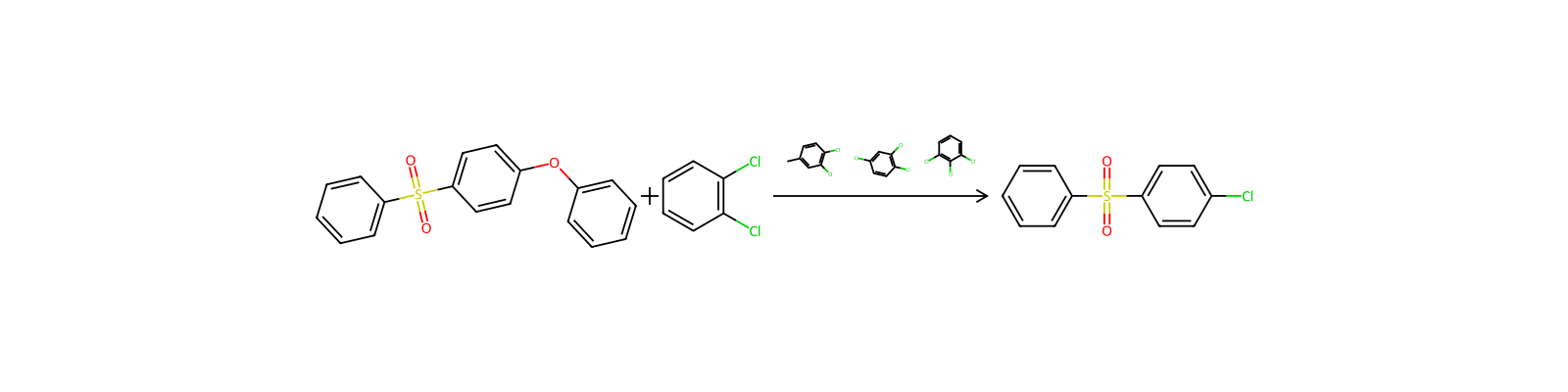
[C:1]1([S:7]([C:10]2[CH:22]=[CH:21][C:13](OC3C=CC=CC=3)=[CH:12][CH:11]=2)(=[O:9])=[O:8])[CH:6]=[CH:5][CH:4]=[CH:3][CH:2]=1.C1C=CC([Cl:29])=C(Cl)C=1>ClC1C=C(C)C=CC=1Cl.ClC1C=CC(Cl)=CC=1Cl.ClC1C(Cl)=C(Cl)C=CC=1>[C:1]1([S:7]([C:10]2[CH:22]=[CH:21][C:13]([Cl:29])=[CH:12][CH:11]=2)(=[O:9])=[O:8])[CH:6]=[CH:5][CH:4]=[CH:3][CH:2]=1Participants


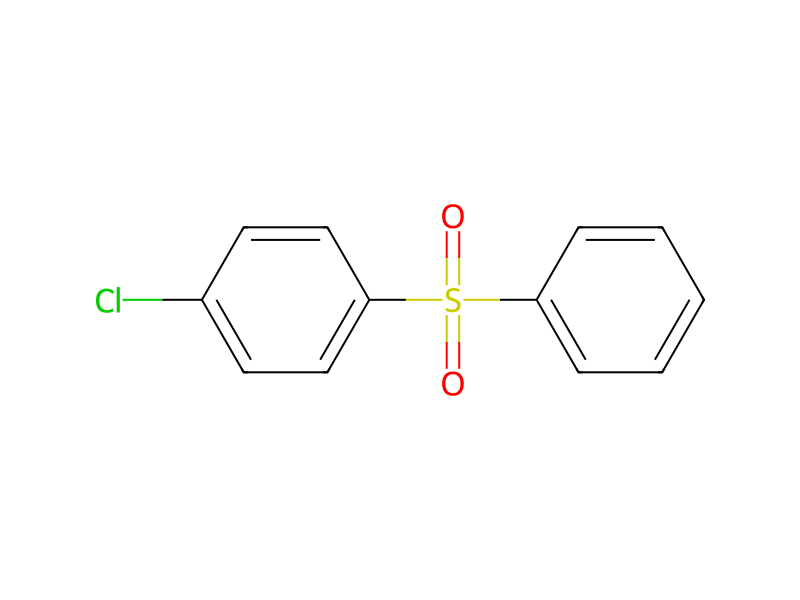
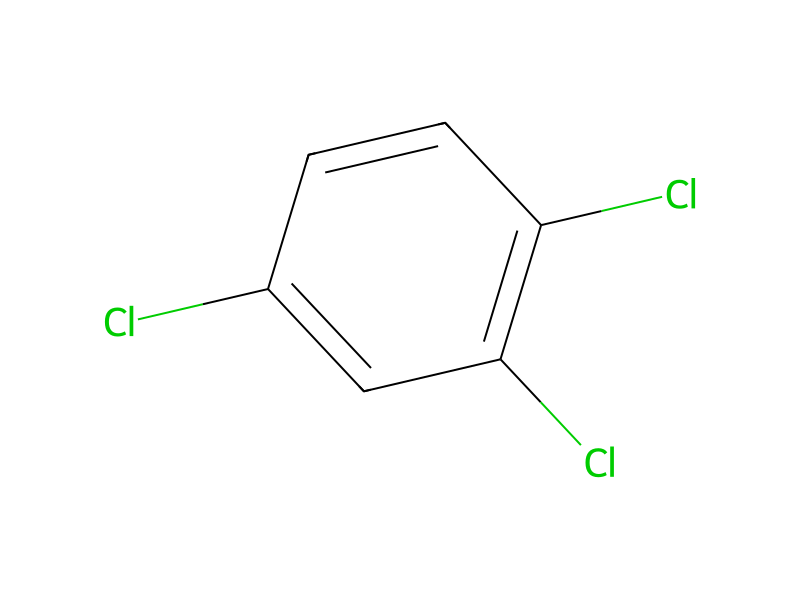


Procedure
FIGS. 1 and 2 illustrate the behavior of the new phase transfer catalysts in the formation of 1,1′-(1-methylethylidene)bis[4-[4-(phenylsulfonyl)phenoxy]benzene (CAS No. 90139-53-0). When the P2-EthylMethyl mesylate was used as a PTC at 1.0 mole % in the model reaction in refluxing o-DCB at 180° C. (See 4 (FIG. 1)), the reaction exhibited pseudo-first order kinetics. This indicates that no catalyst decomposition nor diminution in rate was occurring during the reaction. In order to further test the stability of the phosphazenium salt, similar reactions were carried out at higher temperatures, in 3,4-dichlorotoluene (bp=200° C.) (See 6 (FIG. 1)) and in 1,2,4-trichlorobenzene (bp=214° C.) (See 2 (FIG. 1)). As shown in FIG. 1, even at 200° C., essentially linear reaction kinetics were observed, indicating no decomposition of the P2-EthylMethyl mesylate phase transfer catalyst. In trichlorobenzene, only a small amount of decomposition was observed, after 60 minutes (See 2 (FIG. 1)). In this instance only 0.5 mole % catalyst was used, since after initial range-finding experiments it was determined that reaction using 1.0 mole % would be too fast to follow accurately at 214° C.
Workup
- customwas occurring during the reaction
- customAs shown in FIG. 1, even at 200° C.
- customessentially linear reaction kinetics
- customsince after initial range-finding experiments it was determined that reaction
- customto follow accurately at 214° C.
Sources & evidence
- ORD record
- ord-d489113f7fe0433aacb63f30a216fb3e
- Source dataset
- uspto-grants-2010_04
- Patent number
- US07705190B2
Reaction notes
Loading…