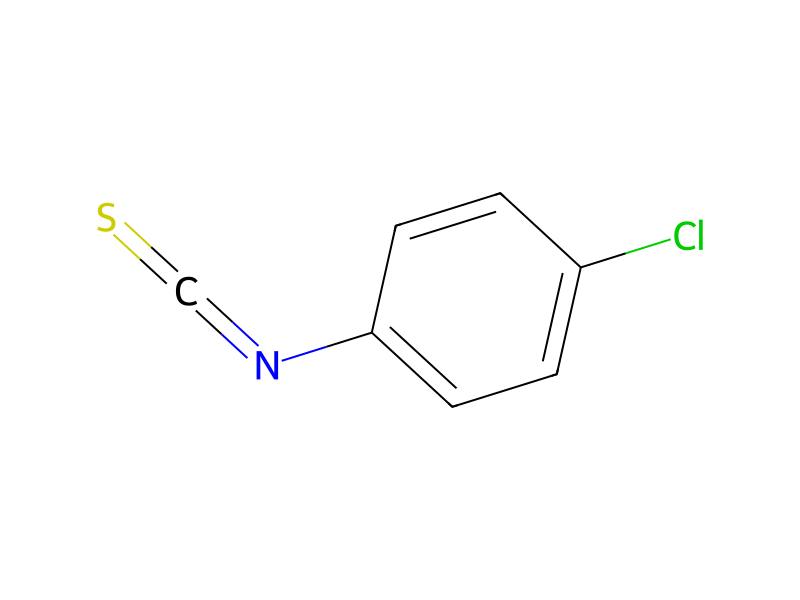
4-Chlorophenyl isothiocyanate → HCID 13191291, compound
Reaction equation

[F:1][CH:2]([F:21])[O:3][C:4]1[CH:9]=[CH:8][C:7]([C:10]2[CH:14]([C:15]3[CH:20]=[CH:19][CH:18]=[CH:17][CH:16]=3)[CH2:13][NH:12][N:11]=2)=[CH:6][CH:5]=1.[Cl:22][C:23]1[CH:28]=[CH:27][C:26]([N:29]=[C:30]=[S:31])=[CH:25][CH:24]=1>C(OCC)C>[Cl:22][C:23]1[CH:28]=[CH:27][C:26]([NH:29][C:30]([N:12]2[CH2:13][CH:14]([C:15]3[CH:16]=[CH:17][CH:18]=[CH:19][CH:20]=3)[C:10]([C:7]3[CH:6]=[CH:5][C:4]([O:3][CH:2]([F:1])[F:21])=[CH:9][CH:8]=3)=[N:11]2)=[S:31])=[CH:25][CH:24]=1Participants
4
Reactant 2

Product 1

Reagents, catalysts & solvents 1

Procedure
A mixture of 5.8 g. of 3-(4-difluoromethoxyphenyl)-4-phenyl-2-pyrazoline and 3.4 g. of 4-chlorophenylisothiocyanate in 200 ml. of anhydrous ethyl ether was refluxed for 6 hours to react them. After cooling the reaction mixture, the precipitated crystal (6.1 g.) was separated by a filtration. It was confirmed that the product was 1-(4-chlorophenylthiocarbamoyl)-3-(4-difluoromethoxyphenyl)-4-phenyl-2-pyrazoline (melting point of 158.0°-161.0° C.) by the NMR spectrum.
Workup
- additionA mixture of 5.8 g
- customto react them
- temperatureAfter cooling the reaction mixture
- customthe precipitated crystal (6.1 g.) was separated by a filtration
Sources & evidence
- ORD record
- ord-7215355e89ad48d3846426d8fb9e2113
- Source dataset
- uspto-grants-1983_10
- Patent number
- US04407813
Reaction notes
Loading…