2-Chlorobenzoxazole → HCID 12763534, compound
Reaction equation

[CH:1]([N:4]([O:9][CH2:10][CH2:11][O:12][CH2:13][CH3:14])[C:5](=[O:8])[CH2:6][OH:7])([CH3:3])[CH3:2].Cl[C:16]1[O:17][C:18]2[CH:24]=[CH:23][CH:22]=[CH:21][C:19]=2[N:20]=1.[OH-].[K+]>C(O)(C)C>[CH:1]([N:4]([O:9][CH2:10][CH2:11][O:12][CH2:13][CH3:14])[C:5](=[O:8])[CH2:6][O:7][C:16]1[O:17][C:18]2[CH:24]=[CH:23][CH:22]=[CH:21][C:19]=2[N:20]=1)([CH3:3])[CH3:2]Participants
Reactant 3
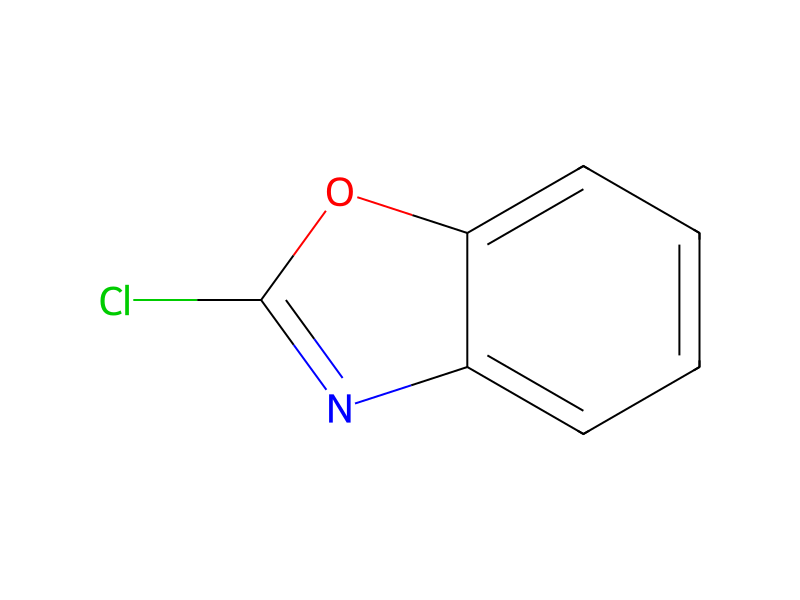


Product 1

Reagents, catalysts & solvents 1

Procedure
First 20.5 g (0.1 mole) of hydroxyacetic acid N-isopropyl-N-(2-ethoxyethoxy)-amide and then 15.4 g (0.1 mole) of 2-chlorobenzoxazole were added dropwise to a solution of 6.2 g (0.11 mole) of potassium hydroxide in 200 ml of isopropanol at 0° to 5° C., and the mixture was then subsequently stirred for 6 hours, without cooling. The solvent was then distilled off in vacuo, the residue was dissolved in 200 ml of toluene and the solution was extracted by shaking once with 100 ml of water. The organic phase was dried over sodium sulphate and evaporated in vacuo. The residue was subjected to incipient distillation at 60° C. under a high vacuum. 30.3 g (94% of theory) of benzoxazol-2-yl-oxyacetic acid N-isopropyl-N-(2-ethoxy-ethoxy)-amide were obtained in this manner in the form of a light brown oil with a refractive index nD22 of 1.4986.
Workup
- temperaturewithout cooling
- distillationThe solvent was then distilled off in vacuo
- dissolutionthe residue was dissolved in 200 ml of toluene
- extractionthe solution was extracted
- stirringby shaking once with 100 ml of water
- dry with materialThe organic phase was dried over sodium sulphate
- customevaporated in vacuo
- distillationThe residue was subjected to incipient distillation at 60° C. under a high vacuum
Sources & evidence
- ORD record
- ord-6164323685534abc85173bac85603538
- Source dataset
- uspto-grants-1983_10
- Patent number
- US04408055
Reaction notes
Loading…