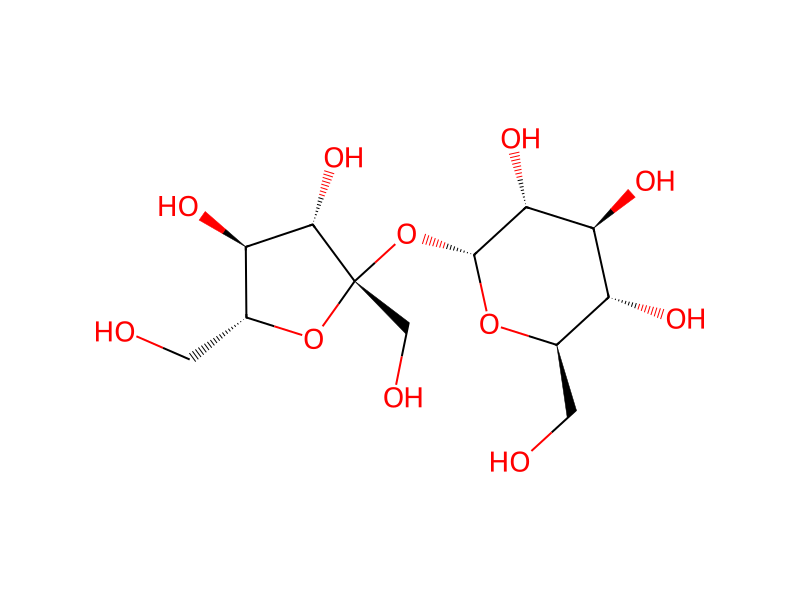
Sucrose → HCID 131713215, compound
Reaction equation

[CH2:1]([OH:23])[C@H:2]1[O:7][C@H:6]([O:8][C@:9]2([CH2:18][OH:19])[O:13][C@H:12]([CH2:14][OH:15])[C@@H:11]([OH:16])[C@@H:10]2[OH:17])[C@H:5]([OH:20])[C@@H:4]([OH:21])[C@@H:3]1[OH:22].[O-:24][Si:25]([O-:27])=[O:26].[Na+].[Na+]>>[Si:25]([OH:7])([OH:27])([OH:24])[OH:26].[CH2:1]([OH:23])[C@H:2]1[O:7][C@H:6]([O:8][C@:9]2([CH2:18][OH:19])[O:13][C@H:12]([CH2:14][OH:15])[C@@H:11]([OH:16])[C@@H:10]2[OH:17])[C@H:5]([OH:20])[C@@H:4]([OH:21])[C@@H:3]1[OH:22]Participants
3


Procedure
An aqueous solution containing sucrose and sodium metasilicate (sucrose content 20% and SiO2 cntent 5%) was passed through a column packed with a cation-exchange resin, Amberlite 200C (H+ form), to effect removal of sodium. There was obtained an aqueous silicic acid/sucrose solution (sucrose content 19% and SiO2 content 4.5%). Twenty (20) g of this solution was spray dried and then heated in an atmosphere of helium at 1440° C. for four hours. Consequently, there was obtained silicon carbide powder having a particle diameter of about 1μ. The crystalline phase was composed of 93% of 3C and 7% of 2H.
Workup
- customremoval of sodium
Sources & evidence
- ORD record
- ord-2f2a4295204046eab8b0218b0dd7e228
- Source dataset
- uspto-grants-1983_10
- Patent number
- US04410502
Reaction notes
Loading…