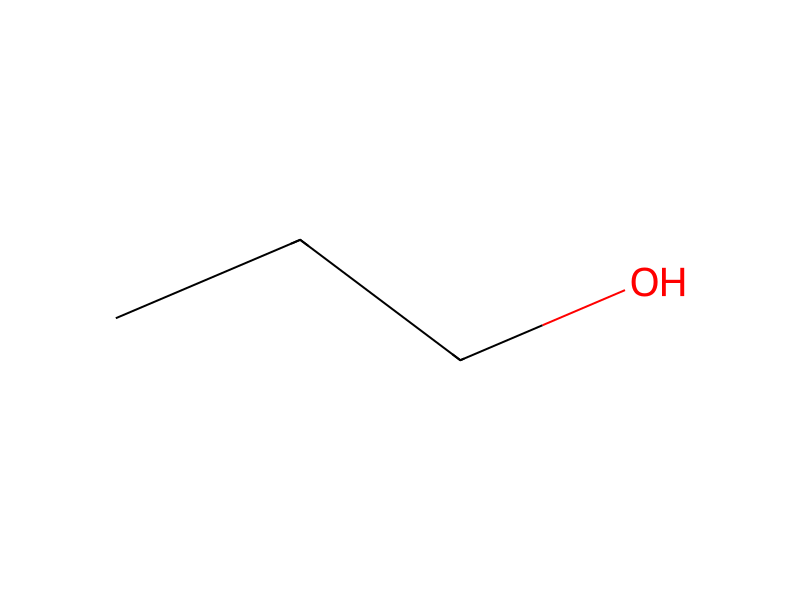
1-Propanol → HCID 20142069, compound
Reaction equation

[Cl:1][C:2]1[CH:11]=[C:10]2[C:5]([CH:6]=[C:7]([O:12][C:13]3[CH:26]=[CH:25][C:16]([O:17][CH:18]([CH3:24])[C:19]([O:21][CH2:22][CH3:23])=[O:20])=[CH:15][CH:14]=3)[CH:8]=[N:9]2)=[CH:4][CH:3]=1.[CH2:27](O)CC>S(=O)(=O)(O)O>[Cl:1][C:2]1[CH:11]=[C:10]2[C:5]([CH:6]=[C:7]([O:12][C:13]3[CH:14]=[CH:15][C:16]([O:17][CH:18]([CH3:24])[C:19]([O:21][CH2:22][CH2:23][CH3:27])=[O:20])=[CH:25][CH:26]=3)[CH:8]=[N:9]2)=[CH:4][CH:3]=1Participants
4
Reactant 2

Product 1

Reagents, catalysts & solvents 1

Procedure
A mixture of ethyl 2-[4-(7-chloroquinolin-3-yloxy)phenoxy]propionate (500 mg), concentrated sulphuric acid (2 drops) and n-propanol (50 ml) was heated under reflux with stirring for 72 hours. The solvent was removed under reduced pressure and the residue was partitioned between dichloromethane and water. The organic layer was separated, dried over magnesium sulphate and evaporated to give n-propyl 2-[4-(7-chloroquinolin-3-yloxy)phenoxy]propionate as a pale brown oil which was characterised by its proton magnetic resonance spectrum (Table 3).
Workup
- temperaturewas heated
- temperatureunder reflux
- customThe solvent was removed under reduced pressure
- customthe residue was partitioned between dichloromethane and water
- customThe organic layer was separated
- dry with materialdried over magnesium sulphate
- customevaporated
Sources & evidence
- ORD record
- ord-0d68c370f5ab4e33a445dfe88e61c0fe
- Source dataset
- uspto-grants-1988_04
- Patent number
- US04738710
Reaction notes
Loading…