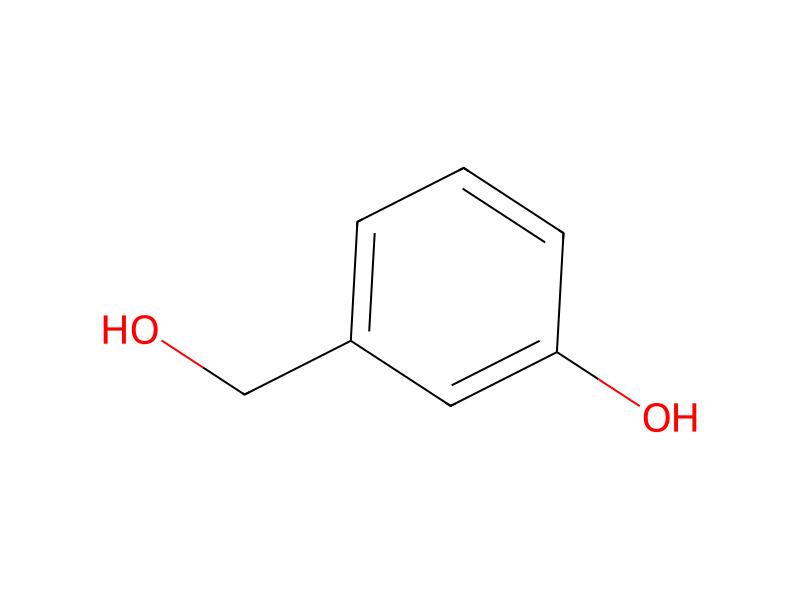
3-Hydroxybenzyl alcohol → 2-{3-[3-(Hydroxymethyl)phenoxy]propyl}-1H-isoindole-1,3(2H)-dione
Reaction equation

[OH:1][C:2]1[CH:3]=[C:4]([CH:7]=[CH:8][CH:9]=1)[CH2:5][OH:6].Br[CH2:11][CH2:12][CH2:13][C:14]1C=C[CH:22]=[C:16]2[C:17]([NH:19][C:20](=[O:21])[C:15]=12)=O.[Na].O.[CH2:27]([OH:29])[CH3:28]>>[OH:6][CH2:5][C:4]1[CH:3]=[C:2]([CH:9]=[CH:8][CH:7]=1)[O:1][CH2:22][CH2:16][CH2:17][N:19]1[C:27](=[O:29])[C:28]2=[CH:11][CH:12]=[CH:13][CH:14]=[C:15]2[C:20]1=[O:21]Participants





Procedure
28.03 g (0.226 mol) of 3-Hydroxybenzyl alcohol are reacted with 60.47 g (0.226 mol) of bromopropylphthalimide and 5.2 g of sodium (0.226 mol) in 400 ml of ethanol at the reflux temperature (5 h). After the ethanol has been drawn off, water is added and the product is extracted with ethyl acetate. Concentration of the organic phase by evaporation yields 60.8 g of a light brown oil from which 38 g (54%) of N-[3-[3-(hydroxymethyl)phenoxy]propyl]phthalimide crystallize as a colourless solid melting at 78° to 80° C. 13.8 ml of hydrazine hydrate (80%) are added to 35.3 g (113 mmol) of N-[3-[3-(hydroxymethyl)phenoxy]propyl]phthalimide in 300 ml of ethanol and the reaction mixture is boiled under reflux for 5 hours. The ethanol is to a large extent removed by evaporation under vacuum, and 100 ml of H2O and 40 ml of conc. HCl (pH 1) are added to the residue. The solid is removed by suction filtration and the filtrate is extracted with ethyl acetate, made alkaline with NaOH (pH 12), saturated with NaCl and extracted with 80:20 CH2Cl2 /CH3OH. After concentration by evaporation and distillation of the oil left behind in a bulb tube (140° to 160° C., 5/10-2 mm Hg), 13.7 g (67% of theoretical) of a light colored solid melting at 68.5 to 69° C. are obtained.
Workup
- extractionthe product is extracted with ethyl acetate
- customConcentration of the organic phase by evaporation
Sources & evidence
- ORD record
- ord-44e4458cb28f4447adc28facc8a20c03
- Source dataset
- uspto-grants-1988_04
- Patent number
- US04738960
Reaction notes
Loading…