1,4-Dinitrobenzene → Aniline
Reaction equation

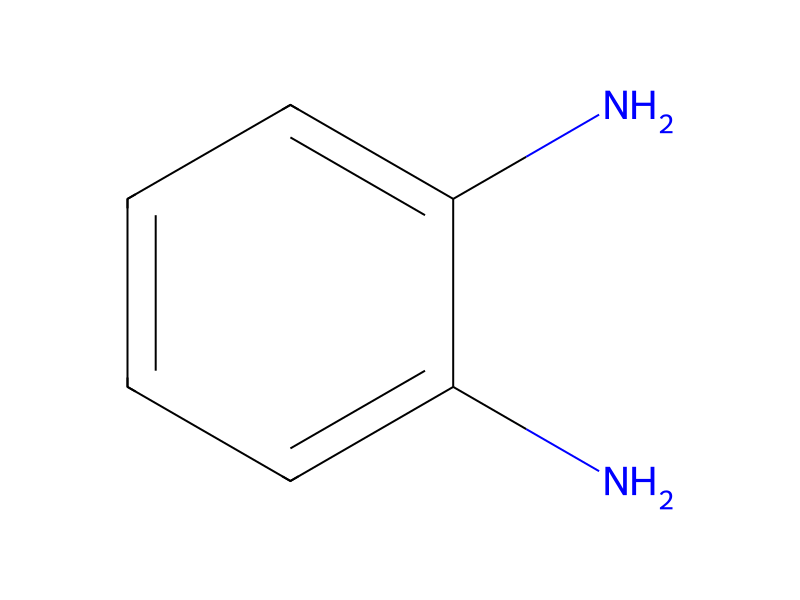
[N+:1]([C:4]1[CH:9]=[CH:8][CH:7]=[CH:6][C:5]=1[N+:10]([O-])=O)([O-])=O.[N+:13]([C:16]1[CH:21]=[CH:20][C:19]([N+:22]([O-])=O)=[CH:18][CH:17]=1)([O-])=O.[H][H]>O>[NH2:1][C:4]1[CH:9]=[CH:8][CH:7]=[CH:6][CH:5]=1.[C:19]1([NH2:22])[CH:20]=[CH:21][CH:16]=[C:17]([NH2:1])[CH:18]=1.[C:5]1([NH2:10])[CH:6]=[CH:7][CH:8]=[CH:9][C:4]=1[NH2:1].[CH:17]1[C:16]([NH2:13])=[CH:21][CH:20]=[C:19]([NH2:22])[CH:18]=1Participants







Procedure
A two-stage process for the co-production of aniline and m-phenylenediamine where, in the first stage, benzene, nitric acid, and sulfuric acid are reacted in a liquid phase to produce in greater amounts nitrobenzene (approximately 70%) and m-dinitrobenzene (approximately 30%), and in lesser or trace amounts o-dinitrobenzene and p-dinitrobenzene, and water; and in the second stage the products of the first stage are reacted with hydrogen in the gas phase to produce aniline (approximately 70%) and m-phenylenediamine (approximately 30%) in greater amounts, and o-phenylenediamine and p-phenylenediamine in lesser amounts, and water. The reaction products are separated by distillation. The first stage of a preferred embodiment of the process is characterized in that a concentrated mixture of nitric acid and sulfuric acid are fed along with mononitrobenzene to a first reactor for producing dinitrobenzene, and then the dilute acid mixture recovered from this first reactor is fed along with benzene to a second reactor for producing the mononitrobenzene used as a reactant in the first reactor. The second stage, which provides the aniline and m-phenylenediamine in major amounts, is characterized in that the hydrogenation is carried out in the gas phase with product aniline serving as a diluent. The process is applicable to the co-production of other aromatic mono- and diamines.
Sources & evidence
- ORD record
- ord-bd5dcd67f6ae4ca29c6b888db71ca9bd
- Source dataset
- uspto-grants-1988_04
- Patent number
- US04740621
Reaction notes
Loading…