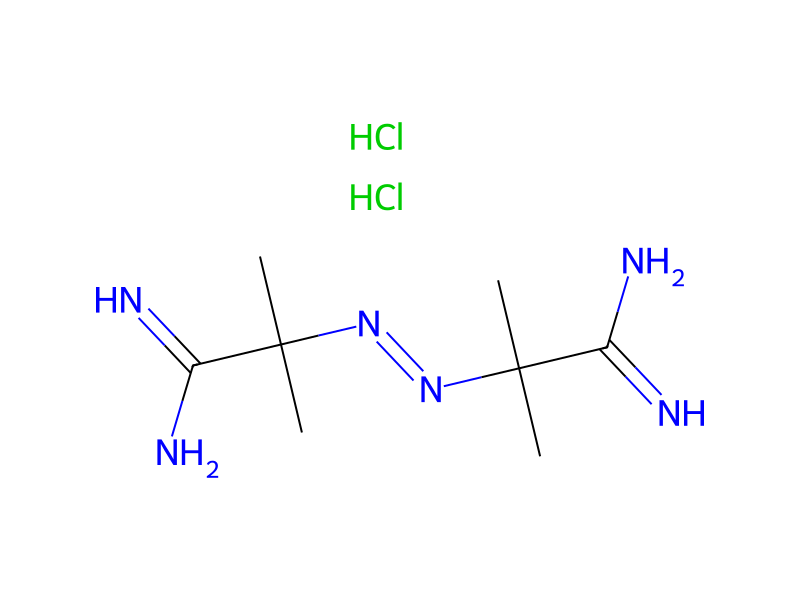
2,2'-Azobis(2-methylpropanimidamide) dihydrochloride → HCID 86757238, compound
Reaction equation

[Br-:1].[CH2:2]([N+:5]1([CH2:15][CH:16]=[CH2:17])[CH2:14][CH2:13][C:12]2[C:7](=[CH:8][CH:9]=[CH:10][CH:11]=2)[CH2:6]1)[CH:3]=[CH2:4].[Cl-:18].[CH2:19]([NH2+:22][CH2:23][CH:24]=[CH2:25])[CH:20]=[CH2:21].Cl.Cl.N(C(C(=N)N)(C)C)=NC(C(=N)N)(C)C>O>[Br-:1].[CH2:15]([N+:5]1([CH2:2][CH:3]=[CH2:4])[CH2:14][CH2:13][C:12]2[C:7](=[CH:8][CH:9]=[CH:10][CH:11]=2)[CH2:6]1)[CH:16]=[CH2:17].[Cl-:18].[CH2:19]([NH2+:22][CH2:23][CH:24]=[CH2:25])[CH:20]=[CH2:21]Participants
5
Reactant 3


Product 1

Reagents, catalysts & solvents 1

Conditions
- Temperature
- 70 °C
Procedure
N,N-diallyl 1,2,3,4-tetrahydroisoquinolinium bromide (15.0 g, EXAMPLE 5), and diallylammonium chloride (2.9 9, EXAMPLE 7) were dissolved in 18 mL deionized water. To this aqueous solution was added 0.5 g of 2,2′-azobis(2-amidinopropane) dihydrochloride, and the reaction mixture was bubbled with a slow stream of nitrogen gas for 45 minutes. While stirring, the temperature was raised to 70° C. The reaction mixture was stirred at 70° C. for 48 hours. After cooling to room temperature, 34.0 9 of viscous polymer solution was obtained.
Workup
- customthe reaction mixture was bubbled with a slow stream of nitrogen gas for 45 minutes
- stirringThe reaction mixture was stirred at 70° C. for 48 hours
- temperatureAfter cooling to room temperature
- custom34.0 9 of viscous polymer solution was obtained
Sources & evidence
- ORD record
- ord-8534f42598324e759b73db7d288aa3dc
- Source dataset
- uspto-grants-2001_08
- Patent number
- US06271264B1
Reaction notes
Loading…