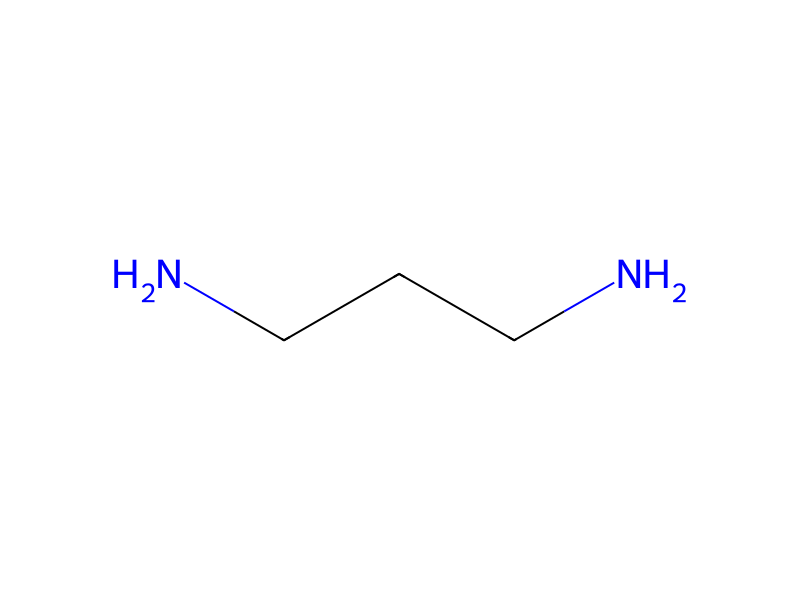
1,3-Propanediamine → HCID 19350326, compound
Reaction equation

[C:1]([O:5][C:6]([O:8]N=C(C1C=CC=CC=1)C#N)=[O:7])([CH3:4])([CH3:3])[CH3:2].[NH2:19][CH2:20][CH2:21][CH2:22][NH2:23]>C(OCC)(=O)C>[C:1]([O:5][C:6]([C:22]([C:6]([O:5][C:1]([CH3:2])([CH3:3])[CH3:4])=[O:8])([NH2:23])[CH2:21][CH2:20][NH2:19])=[O:7])([CH3:4])([CH3:3])[CH3:2].[C:1]([O:5][C:6]([CH:22]([NH2:23])[CH2:21][CH2:20][NH2:19])=[O:7])([CH3:4])([CH3:3])[CH3:2]Participants
Reactant 2

Product 2


Reagents, catalysts & solvents 1

Conditions
- Temperature
- 0 °C
Procedure
Mono-t-butyloxycarbonyl (BOC) 1,3-propanediamine was prepared as follows. 2-(tert-butoxycarbonyloxyimino)-2-phenylacetonitrile (18 g, 73 mmol) was added portionwise over 10 minutes to a solution of 1,3-diaminopropane (12.5 g, 184 mmol) in 100 mL of tetrahydrofiran cooled to 0° C. After four hours at 0° C. the reaction was allowed to warm to 25° C. for two hours. The reaction was diluted with 150 mL of ethyl acetate and washed twice with 100 mL of saturated aqueous sodium chloride. The organic phase was extracted with three 100 mL volumes of 10% aqueous citric acid, the combined aqueous portions were then washed twice with 100 mL of ethyl acetate. The aqueous phase was cooled in an ice bath and the pH was adjusted to approximately 13 with 50% sodium hydroxide. The basic aqueous phase was then extracted with three 100 mL volumes of dichloromethane. The organic portion was then dried with potassium carbonate and filtered. Solvent was removed by rotary evaporation to yield mono-tert-butyloxycarbonyl-1,3-diaminopropane.
Workup
- temperatureto warm to 25° C. for two hours
- washwashed twice with 100 mL of saturated aqueous sodium chloride
- extractionThe organic phase was extracted with three 100 mL volumes of 10% aqueous citric acid
- washthe combined aqueous portions were then washed twice with 100 mL of ethyl acetate
- temperatureThe aqueous phase was cooled in an ice bath
- extractionThe basic aqueous phase was then extracted with three 100 mL volumes of dichloromethane
- dry with materialThe organic portion was then dried with potassium carbonate
- filtrationfiltered
- customSolvent was removed by rotary evaporation
Sources & evidence
- ORD record
- ord-065e0ad0e00147fda55d7bb1e55eeae3
- Source dataset
- uspto-grants-2001_08
- Patent number
- US06271198B1
Reaction notes
Loading…