Benzoxazole → 2,6-Dichlorobenzoxazole
Reaction equation

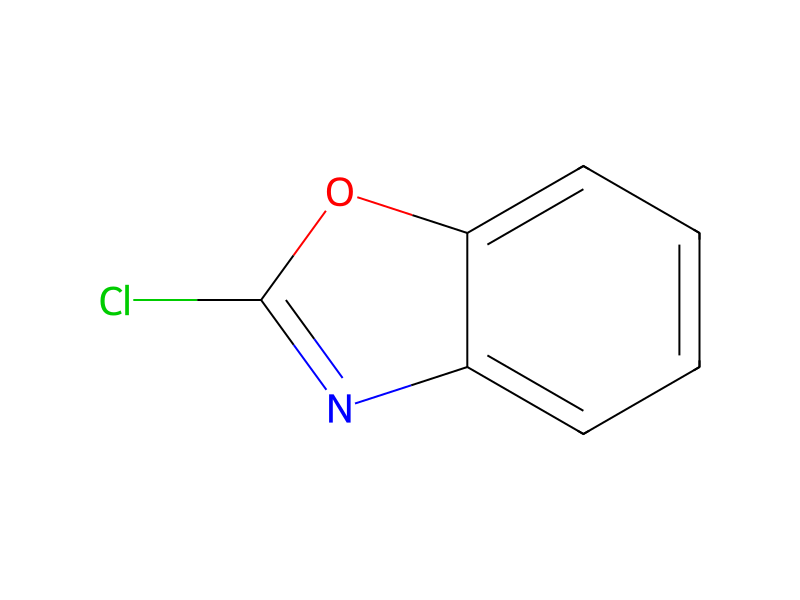
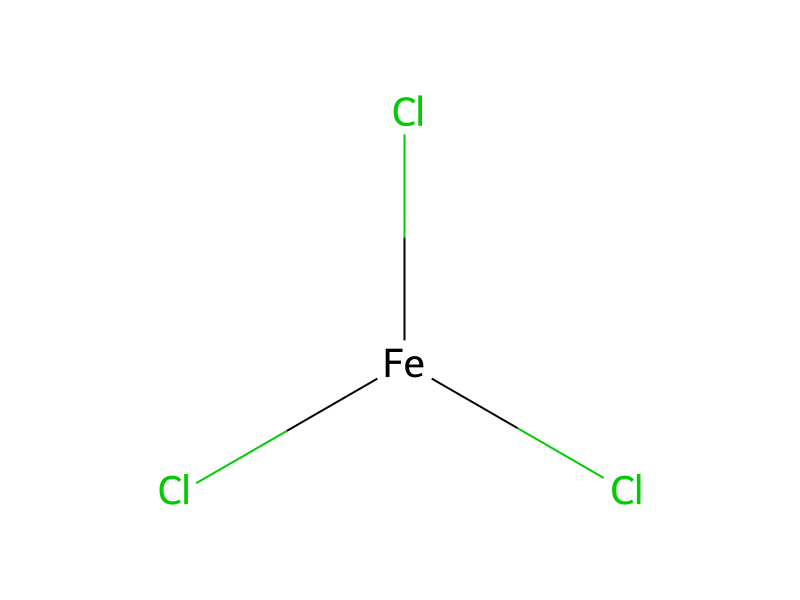
O1C2C=CC=CC=2N=C1.[Cl:10]Cl.[Cl:12][C:13]1[O:14][C:15]2[CH:21]=[CH:20][CH:19]=[CH:18][C:16]=2[N:17]=1>[Fe](Cl)(Cl)Cl.O=P(Cl)(Cl)Cl>[Cl:12][C:13]1[O:14][C:15]2[CH:21]=[C:20]([Cl:10])[CH:19]=[CH:18][C:16]=2[N:17]=1Participants
Reactant 3


Product 1

Reagents, catalysts & solvents 2

Procedure
With efficient stirring, 10 g (0.083 mol) of 1,3-benzoxazole (>99% pure), together with 100 ml of POCl3 and 0.2 g of iron (III) chloride (dry), were heated to 100° C. At this temperature, chlorine gas was introduced under the surface of the liquid. GC control of the reaction showed that initially 2-chlorobenzoxazole was formed which, with further substitution, then reacted to give 2,6-dichlorobenzoxazole. Once all of the starting material had been consumed, the reaction was terminated. According to GC analysis, 21.5% of 2-chlorobenzoxazole and 71% of 2,6-dichlorobenzoxazol had been formed. The crude mixture was worked up by distillation. POCl3 and 2-chlorobenzoxazole were collected in a first fraction and could be employed directly for a further batch. The second fraction yielded 11.0 g of 2,6-dichlorobenzoxazole (GC>99% pure) (>70% of theory). Taking into account the recycling of the 2-chlorobenzoxazole, a total yield of >92% of theory was obtained.
Workup
- customwas formed which
- customwith further substitution, then reacted
Sources & evidence
- ORD record
- ord-b329f7a2e41a45bd9c566599af82b374
- Source dataset
- uspto-grants-2001_08
- Patent number
- US06274739B1
Reaction notes
Loading…