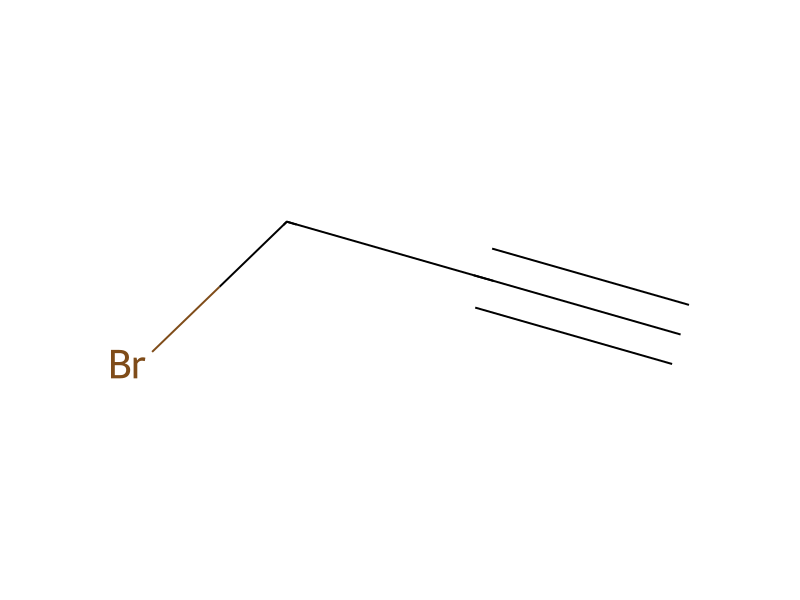
Propargyl bromide → (2-Oxo-1-prop2-ynyl-pyrrolidin-3-(s)-yl)-carbamic acid benzyl ester
Reaction equation

[H-].[Na+].[CH2:3]([O:10][C:11](=[O:19])[NH:12][C@H:13]1[CH2:17][CH2:16][NH:15][C:14]1=[O:18])[C:4]1[CH:9]=[CH:8][CH:7]=[CH:6][CH:5]=1.[CH2:20](Br)[C:21]#[CH:22]>C1COCC1.CN(C=O)C>[CH2:3]([O:10][C:11](=[O:19])[NH:12][C@H:13]1[CH2:17][CH2:16][N:15]([CH2:22][C:21]#[CH:20])[C:14]1=[O:18])[C:4]1[CH:5]=[CH:6][CH:7]=[CH:8][CH:9]=1Participants
5
Reactant 3


Product 1

Reagents, catalysts & solvents 1

Procedure
Sodium hydride (1.11 g, 27.7 mmol, 60% mineral oil dispersion) is added to a solution of [2-oxopyrrolidin-3-(S)-yl]-carbamic acid benzyl ester (6.20 g, 26.4 mmol) in THF/DMF (88 mL, 3/1 v/v) at 0° C. The mixture is stirred for 5 min. then propargyl bromide (4.4 mL, 49.4 mmol) is added dropwise. The resulting solution is stirred for 1 h then brought to room temperature and stirred for 2 h. The reaction is quenched with saturated ammonium chloride solution then diluted with ethyl acetate and washed with water (×4) and brine. The organic layer is dried over MgSO4, filtered and concentrated to dryness. The residue is purified by column chromatography eluting with 5% MeOH/CH2Cl2 to give the product (7.20 g, 26.4 mmol) as a white solid.
Workup
- stirringThe resulting solution is stirred for 1 h
- customthen brought to room temperature
- stirringstirred for 2 h
- customThe reaction is quenched with saturated ammonium chloride solution
- additionthen diluted with ethyl acetate
- washwashed with water (×4) and brine
- dry with materialThe organic layer is dried over MgSO4
- filtrationfiltered
- concentrationconcentrated to dryness
- customThe residue is purified by column chromatography
- washeluting with 5% MeOH/CH2Cl2
Sources & evidence
- ORD record
- ord-e3cfd0786066486f9b80f99ee0f17c94
- Source dataset
- uspto-grants-2001_08
- Patent number
- US06281227B1
Reaction notes
Loading…