Phosphorus oxide (P4O10) → Sodium Tripolyphosphate
Reaction equation

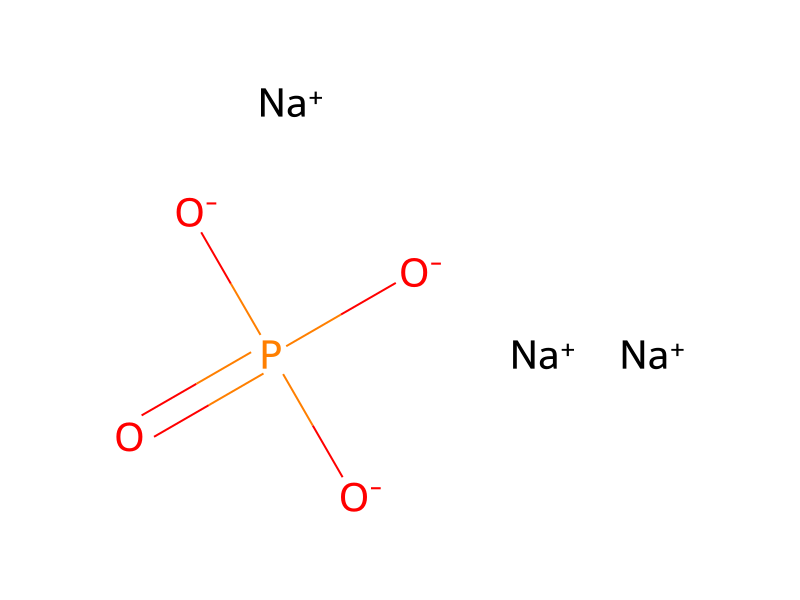
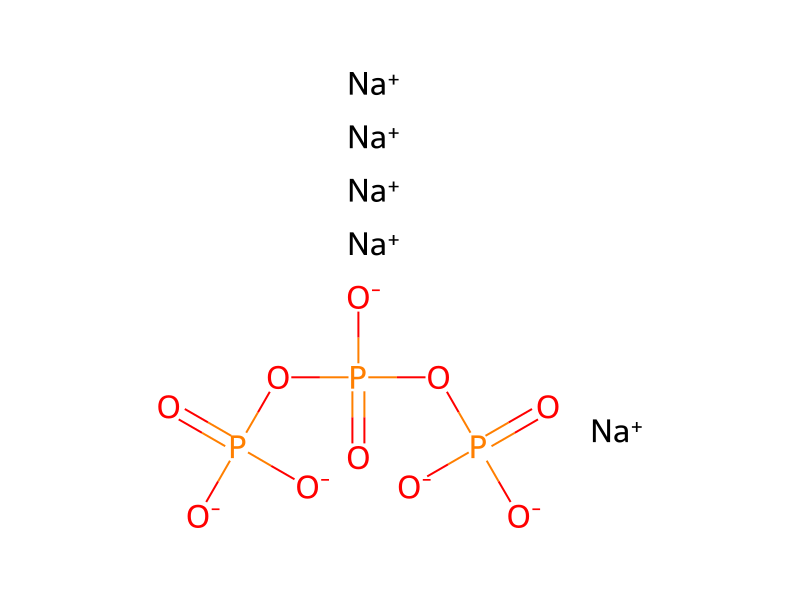
[P:1]([O-:5])([O-:4])([O-:3])=[O:2].[Na+:6].[Na+].[Na+].[O:9]=[P:10]12[O:21]P3(O[P:12]([O:14]P(O3)([O:17]1)=O)(=[O:13])[O:11]2)=O>>[O-:2][P:1]([O:5][P:12]([O:11][P:10]([O-:21])([O-:17])=[O:9])([O-:14])=[O:13])([O-:4])=[O:3].[Na+:6].[Na+:6].[Na+:6].[Na+:6].[Na+:6]Participants

Procedure
The loaded organic extract fed to stripping column 20 was treated with water countercurrently to extract P2O5 values and yielded a purified acid stream containing the equivalent of 8,978 pounds per hour of P2O5 and 5.6 pounds per hour of fluoride ion. This purified acid was passed through line 22 into make up reactor 24 along with enough sodium carbonate to yield 7,497 pounds per hour of sodium ion. The resulting reaction yielded an ortho liquor containing a sodium orthophosphate solution having a Na:P of about 1.67, a P2O5 content of 9,127 pounds per hour and fluoride ion in amounts of 9.2 pounds per hour. The ortho liquor was removed from reactor 24 through line 28 and introduced into a spray dryer 30. The ortho liquor was heated by downwardly directed burners to yield 8,829 pounds per hour of sodium tripolyphosphate containing not more than about 1 pound per hour of fluoride ion. The sodium tripolyphosphate product was removed through line 34 and contained about 100 ppm of fluoride, which is considered acceptable for all but food grade purposes.
Workup
- customThe resulting reaction
- customyielded an ortho liquor
- customThe ortho liquor was removed from reactor 24 through line 28
- additionintroduced into a spray dryer 30
- temperatureThe ortho liquor was heated by downwardly directed burners
Sources & evidence
- ORD record
- ord-b8a1346110a5415998e651bd2501f4f9
- Source dataset
- uspto-grants-1987_06
- Patent number
- US04676963
Reaction notes
Loading…