Dimethyl Sulfoxide → HCID 20194905, compound
Reaction equation

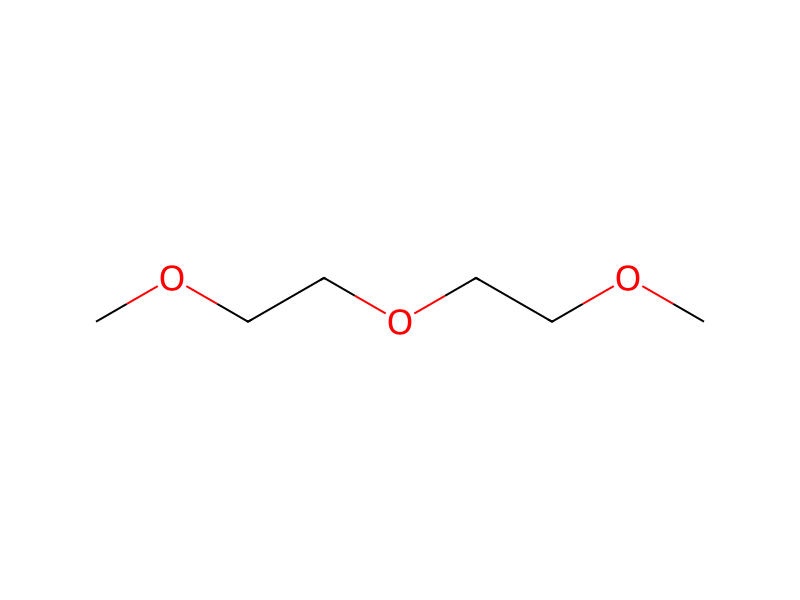
[CH3:1][O:2][CH:3]1[O:8][CH2:7][C:6](C(OC)=O)([C:9]([O:11]C)=[O:10])[CH2:5][CH2:4]1.CS(C)=O>COCCOCCOC>[CH3:1][O:2][CH:3]1[O:8][CH2:7][CH:6]([C:9]([OH:11])=[O:10])[CH2:5][CH2:4]1Participants
Reactant 2


Product 1

Reagents, catalysts & solvents 1
Procedure
Dimethyl 4,4-dimethoxybutane-1,1-dicarboxylate was prepared by the Michael addition of dimethyl malonate to acrolein followed by acetalization. Subsequent hydroxymethylation with formaldehyde in the presence of potassium hydrogen carbonate gave nearly quantitatively dimethyl 1-hydroxy-5,5-dimethoxypentane-2,2-dicarboxylate. This compound rapidly underwent acid-catalyzed intramolecular cyclization in a dilute solution in benzene, aided by the favored six-membered ring formation, to yield dimethyl 6-methoxytetrahydropyran-3,3-dicarboxylate. The tetrahydropyran derivative was saponified to the free dicarboxylic acid, which was then decarboxylated in diglyme or dimethyl sulfoxide at 120°-140° C. to give 6-methoxytetrahydropyran-3-carboxylic acid as a stereoisomeric mixture in a quantitative yield. The carboxylic acid was then heated in a dilute solution in toluene in the presence of a catalytic amount of p-toluenesulfonic acid to give the desired bicyclic lactone (I). The overall yield based on acrolein was approximately 20%.
Sources & evidence
- ORD record
- ord-5232974d6ba64d47b156c5cacdbbffa5
- Source dataset
- uspto-grants-1987_06
- Patent number
- US04677190
Reaction notes
Loading…