Aniline → Carbanilide
Reaction equation

[N+:1]([C:4]1[CH:9]=[CH:8][CH:7]=[CH:6][CH:5]=1)([O-])=O.[NH2:10][C:11]1[CH:16]=[CH:15][CH:14]=[CH:13][CH:12]=1.CN(C)[C:19](N(C)C)=[O:20].[C]=O>[C-]#[O+].[C-]#[O+].[C-]#[O+].[C-]#[O+].[C-]#[O+].[C-]#[O+].[C-]#[O+].[C-]#[O+].[C-]#[O+].[C-]#[O+].[C-]#[O+].[C-]#[O+].[Ru].[Ru].[Ru].C1(C)C=CC=CC=1>[C:4]1([NH:1][C:19]([NH:10][C:11]2[CH:16]=[CH:15][CH:14]=[CH:13][CH:12]=2)=[O:20])[CH:9]=[CH:8][CH:7]=[CH:6][CH:5]=1Participants
Reactant 4


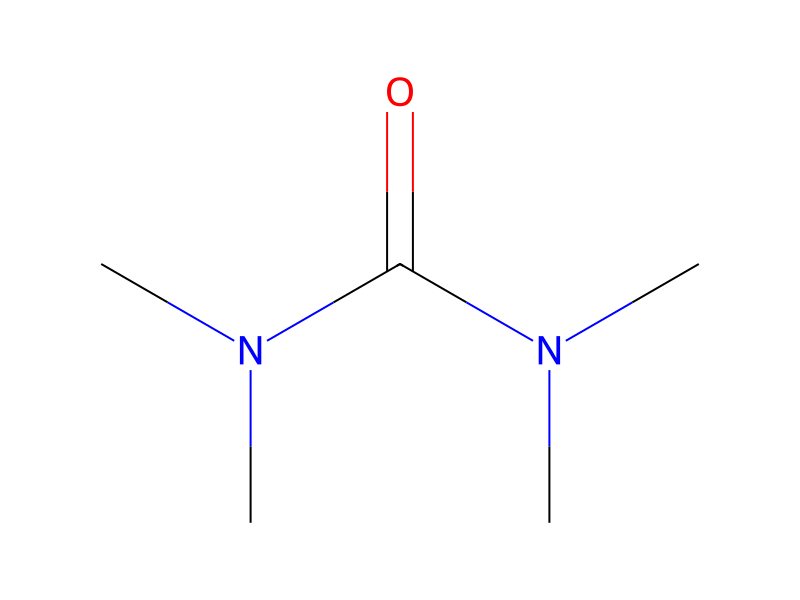

Product 1

Reagents, catalysts & solvents 2


Procedure
Into a 200 ml autoclave equipped with a magnetic stirrer were introduced 5.6 g of nitrobenzene, 7.8 g of aniline, 27 ml of toluene, 6.3 g of N,N,N',N'-tetramethylurea (referred to hereafter as TMU), and 20 mg of Ru3 (CO)12. Thereafter the atmosphere within the system was changed to one of carbon monoxide, within was set at a pressure of 50 kg/cm2. Subsequently the reaction was carried out at 160° C. for 2 hours, with continuous stirring. After completion of the reaction, the system was cooled to room temperature, and following gas evacuation, the reaction liquor was filtered and 3.5 g of N,N'-diphenyl urea crystals obtained. The filtrate was analyzed by gas chromatography and high speed liquid chromatography, and found to contain 0.1 g of N,N'-diphenyl urea and 2.9 g of nitrobenzene. This indicated that the TOF (Turn Over Frequency) of N,N'-diphenyl urea production was 100 h-1 based on catalyst metal atoms, and the selectivity based on nitrobenzene was 94%.
Workup
- customInto a 200 ml autoclave equipped with a magnetic stirrer
- customAfter completion of the reaction
- filtrationthe reaction liquor was filtered
Sources & evidence
- ORD record
- ord-7c206bd084c24a868c2721b6bd500986
- Source dataset
- uspto-grants-1992_07
- Patent number
- US05130464
Reaction notes
Loading…