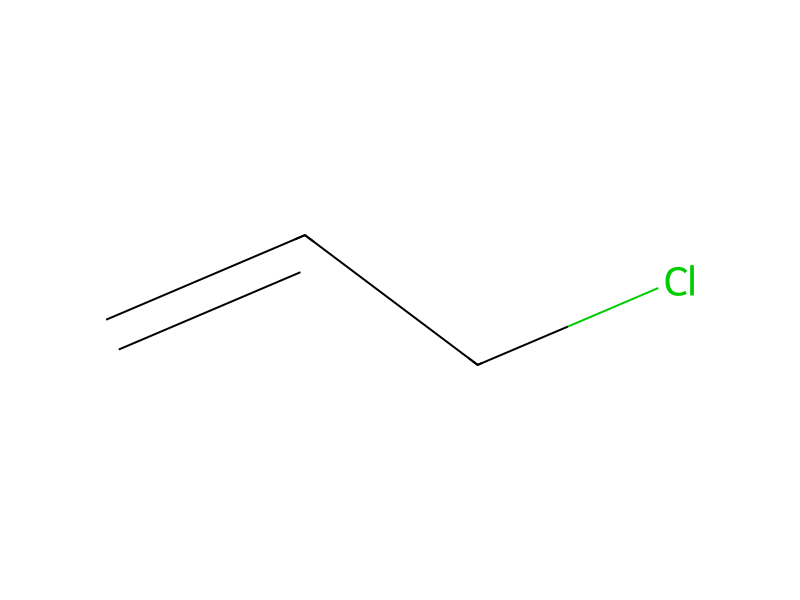
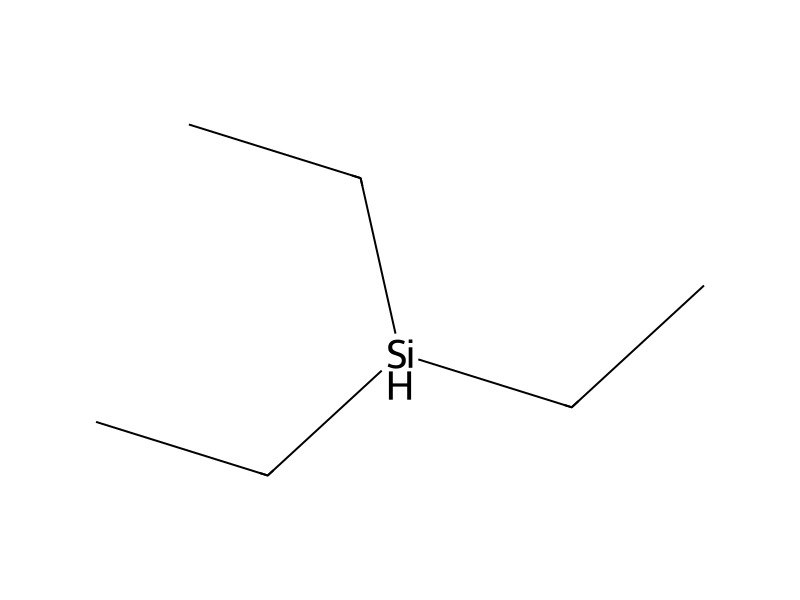
Allyl chloride → (3-Chloropropyl)(triethyl)silane
Reaction equation

[CH2:1]([Cl:4])[CH:2]=[CH2:3].[SiH:5]([CH2:10][CH3:11])([CH2:8][CH3:9])[CH2:6][CH3:7].[SiH](Cl)(Cl)Cl>>[Si:5]([CH2:3][CH2:2][CH2:1][Cl:4])([CH2:10][CH3:11])([CH2:8][CH3:9])[CH2:6][CH3:7]Participants
4


Conditions
- Temperature
- 44 °C
Procedure
In a 50 ml apparatus, there were combined 7.7 g (0.1 mol) of allyl chloride and 0.05 ml of Pt catalyst solution. the mixture was heated to 44° C. and addition of a mixture of 11.6 g (0.1 mol) of Et3SiH and 1.4 g (0.01 mol) of Cl3SiH begun. Reaction was heated up to 54.5° C. during addition (30 min). There was a violent exothermic reaction from 62° C. to 110° C. 16 min later. Vacuum distillation yielded 7.79 g (40.5%) of Et3SiCH2CH2CH2Cl, with a Et3SiCH2CH2CH2Cl/Et3SiCl selectivity ratio of 1.23. This example and the previous one show that the preferred sequence of combination of reactants for most effective Cl3SiH promotion of the reaction of Et3SiH with allyl chloride is that of Example 24.
Workup
- customReaction
- temperaturewas heated up to 54.5° C. during addition (30 min)
- customa violent exothermic reaction from 62° C. to 110° C
- custom16 min
- distillationVacuum distillation
Sources & evidence
- ORD record
- ord-5761f7db8f3a4ee096a35db6e70f0979
- Source dataset
- uspto-grants-1986_09
- Patent number
- US04614812
Reaction notes
Loading…